Low-volume MIM projects should be reviewed by tooling investment, design stability, process validation, and expected production volume. Core conclusion: The key decision is not only whether a part can be molded. The project must also justify tooling, trial correction, inspection setup, and future repeat production. Low-volume MIM projects should be reviewed as a production-readiness and …
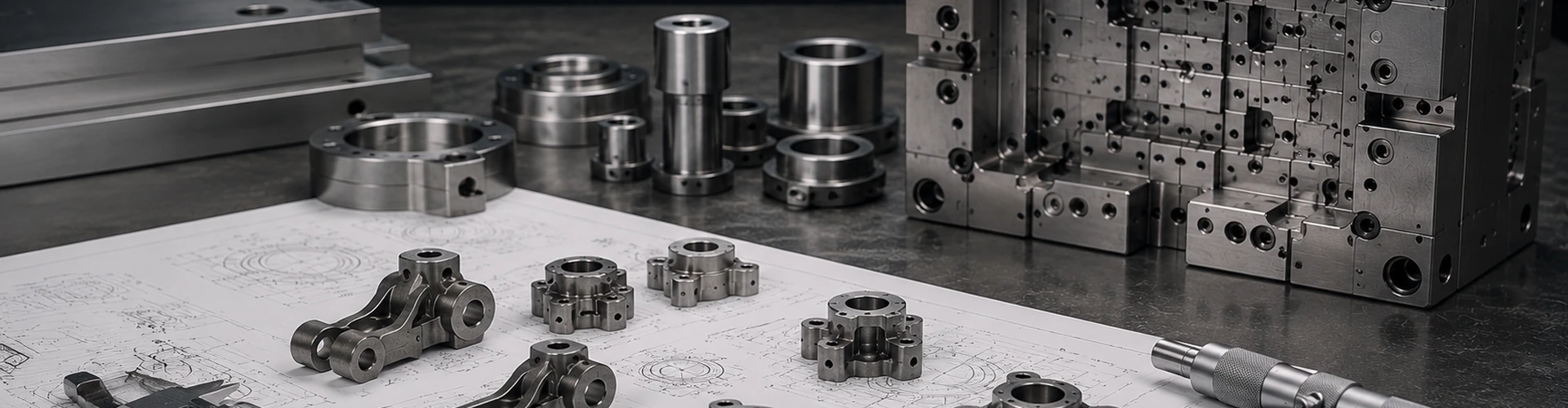
Core conclusion: The key decision is not only whether a part can be molded. The project must also justify tooling, trial correction, inspection setup, and future repeat production.
Low-volume MIM projects should be reviewed as a production-readiness and cost-justification decision, not as a simple molding feasibility question. The first order may be small, but production tooling, trial correction, shrinkage validation, inspection setup, and yield allowance still have to be prepared before stable parts can be produced. MIM may deserve review when a part is small, complex, design-stable, costly to machine, and likely to move into repeat annual production. It is usually weak for prototype-only work, unstable drawings, simple machined shapes, or projects without credible lifetime demand. Before requesting a unit price, confirm the 2D drawing, 3D CAD file, material, critical tolerances, first order quantity, expected annual volume, and whether CNC machining or metal 3D printing should validate the design before MIM tooling.
Primary decision
Can the project justify MIM tooling and validation before repeat production is confirmed?
Most suitable cases
Small, complex, design-stable metal parts with credible future annual volume.
Weak cases
Prototype-only parts, unstable drawings, simple machined shapes, or unclear demand.
Review input
Drawing, CAD file, material, tolerances, first order quantity, annual volume, and current process.
Low-Volume MIM Quick Qualification Matrix
Use this quick matrix before asking for a low-volume MIM unit price. It helps separate projects that should remain in prototype validation from projects that may deserve a drawing-based MIM cost review.
| If Your Project Looks Like This | Suggested Next Step | Why This Matters |
|---|---|---|
| Prototype-only project, changing drawing, no confirmed future demand. | Use CNC machining or metal 3D printing first. | MIM tooling is difficult to justify before design freeze and repeat demand are clear. |
| Small complex metal part, stable drawing, current CNC cost pressure, likely future annual volume. | Submit drawings for MIM cost and manufacturability review. | Tooling may be reasonable when complexity and repeat production can support amortization. |
| Geometry can be compacted and ejected in a relatively simple pressing direction. | Compare pressed PM before selecting MIM. | Pressed PM may be more economical when the part does not require complex three-dimensional MIM geometry. |
| Tight tolerances are applied across most dimensions without clear functional priority. | Review critical dimensions, datum strategy, and secondary machining needs before tooling. | Over-specified tolerances can increase inspection, correction, and post-processing cost. |
Low Volume Is a Cost Justification Problem, Not Only a Manufacturing Problem
Many low-volume parts are not rejected because MIM is technically impossible. They are rejected because the project cannot justify the cost structure behind MIM. A small stainless steel latch, bracket, gear segment, instrument component, or electronic hardware part may be moldable. It may also survive debinding and sintering. However, that does not automatically mean it should move into MIM tooling.
For a broader cost structure, the complete MIM cost drivers page explains tooling, material, molding, debinding, sintering, secondary operations, inspection, and volume-related cost drivers. This page focuses only on the low-volume decision boundary. For deeper support on upfront tooling logic, see why MIM tooling cost is high and how annual volume affects MIM tooling amortization and unit price.
| Review Question | What It Means in MIM Review | Why It Matters for Low Volume |
|---|---|---|
| Can the part be molded? | Geometry, feedstock flow, gate position, ejection, and green part handling. | Confirms basic forming feasibility, but does not prove commercial justification. |
| Can it survive debinding and sintering? | Shrinkage, distortion, cracking risk, support method, and material behavior. | Confirms process stability before the project is treated as production-ready. |
| Can the drawing stay stable? | Design freeze, tolerance strategy, critical dimensions, and assembly interfaces. | Reduces mold modification and revalidation risk. |
| Can tooling be amortized? | Expected annual volume, lifetime volume, and current manufacturing cost. | Determines whether the project is commercially reasonable. |
Engineering review point: Before tooling, the key question is not “Can the factory make one batch?” It is “Can this project justify tooling, validation, inspection preparation, and repeat production control?”
Tooling Amortization Is the First Barrier for Low-Volume MIM
Tooling is usually the first major barrier in a low-volume MIM project. A MIM mold is not only a cavity that copies the final part shape. It must consider feedstock flow, cavity filling, gate location, ejection, parting line, green part strength, and sintering shrinkage compensation. If the part has thin walls, micro features, undercuts, internal steps, or tight functional surfaces, the tooling review becomes more important.

Core conclusion: The same tooling investment may be unreasonable for a prototype-only batch but acceptable when the part has stable repeat demand.
| Cost Factor | Why It Becomes Difficult at Low Volume |
|---|---|
| Mold design and fabrication | The investment is paid before production volume is proven. |
| Shrinkage compensation | Dimensional compensation needs engineering judgment and trial confirmation. |
| Trial runs | Trial molding and part review are still needed even when the first batch is small. |
| Mold correction | Correction may be required after dimensional or assembly review. |
| Multi-cavity tooling | Useful for long-term unit cost, but harder to justify when demand is uncertain. |
Tooling cost per part = tooling investment ÷ expected lifetime production volume
This is not a quotation formula. It is a cost review logic. If expected lifetime demand is only a few hundred or a few thousand pieces, the tooling cost carried by each part may be too high. If the same part repeats for many years, tooling investment becomes easier to justify.
Low-Volume Orders Still Require Trial, Correction, and Validation
A small order does not remove the need for MIM process validation. The part still passes through feedstock molding, green part handling, debinding, sintering, and final inspection. Each stage can affect dimensions, density, strength, surface condition, and production yield.

Core conclusion: Quantity changes the cost justification, not the need to confirm molding behavior, shrinkage, sintering stability, and inspection requirements.
| Validation Item | Why It Cannot Be Skipped |
|---|---|
| Mold trial | Confirms filling, gate position, parting line, ejection, and green part stability. |
| Green part handling review | Checks whether fragile features can survive handling before debinding. |
| Debinding check | Helps prevent cracking, distortion, and incomplete binder removal. |
| Sintering review | Confirms shrinkage behavior, distortion risk, density, and support method. |
| Dimensional inspection | Confirms whether critical features, datums, functional surfaces, and inspection requirements match the drawing. |
| Secondary operation review | Checks whether machining, tapping, polishing, coating, or heat treatment still affects cost. |
Low-volume projects often fail when the buyer treats MIM as a shortcut to production. In practice, MIM is a complete production route. Trial, shrinkage review, sintering evaluation, and inspection planning remain necessary before repeatable output can be expected.
Design Stability Can Matter More Than the First Order Quantity
For low-volume MIM, design stability can matter more than the first order quantity. A small batch with a frozen drawing and a clear future volume plan may deserve review. A larger first batch with unstable geometry, changing hole positions, uncertain assembly interfaces, and unrealistic tolerances may still be risky.
MIM tooling is built around a design assumption. If the customer changes wall thickness, holes, bosses, undercuts, gate-sensitive surfaces, or critical datums after tooling starts, the mold may need correction. In some cases, the original tooling concept may no longer match the revised part.
Before starting MIM tooling, confirm:
- The drawing is frozen or close to frozen.
- Critical dimensions are clearly identified.
- Tolerances are functional, not over-specified everywhere.
- Material requirements are defined.
- Surface finish and secondary operation requirements are known.
- Future annual volume is credible.
- The current process has a cost, yield, or manufacturability problem that MIM may solve.
If the design is still changing, it may be better to review the part through a MIM design review before tooling and then submit the drawing for review before asking for final MIM tooling cost.
When Low-Volume MIM Is Usually Not Worth It
Low-volume MIM is usually difficult to justify when the project has no path toward repeat production. In these cases, the process may be technically possible but commercially weak.
| Situation | Why MIM Is Usually Hard to Justify |
|---|---|
| Prototype-only project | Tooling investment cannot be spread across future production. |
| Drawing is not frozen | Mold correction and revalidation risk increase. |
| Simple turned or milled geometry | CNC machining may be faster and more direct. |
| Large simple part | MIM’s advantage in small complex geometry becomes weaker. |
| Pressed PM can meet the shape and performance need | MIM may add unnecessary cost if compaction geometry is sufficient. |
| Heavy secondary machining remains | The near-net-shape advantage is reduced. |
| Tight tolerances are applied everywhere | Inspection and secondary finishing cost may increase. |
| No expected annual or lifetime demand | Tooling amortization has no clear basis. |
This does not mean every low-volume inquiry should be rejected. It means the project should be reviewed with the correct decision logic. If the part is low quantity, simple, unstable, and prototype-only, the better route is usually to validate the design first before considering MIM tooling.
When Low-Volume MIM May Still Deserve Review
Low volume does not automatically disqualify a project. Some low-volume parts still deserve MIM review when there is a strong engineering or future-production reason.
| Low-Volume Condition | Why It May Still Support MIM Review |
|---|---|
| Small and complex geometry | MIM may reduce repeated machining, fixturing, and material removal. |
| Expensive CNC baseline | Tooling may become reasonable if repeat demand is likely. |
| Difficult-to-machine material | MIM may reduce machining pressure after tooling is validated. |
| Multiple parts can be consolidated | Assembly, welding, or secondary operations may be reduced. |
| Design is stable | Mold modification risk is lower. |
| Future annual volume is likely | The first order may support early production planning. |
| Customer accepts tooling as a production investment | The decision is based on lifecycle cost, not only first-batch price. |
The strongest low-volume MIM candidates are not simply small orders. They are early-stage production projects with credible repeat demand, clear cost pressure from the current process, and a design stable enough to support tooling investment.
Low-Volume MIM vs CNC, Metal 3D Printing, Casting, and PM
For low-volume projects, MIM should be compared with other manufacturing routes before tooling is approved. The comparison should focus on project stage, design stability, and expected repeat demand, not only first-batch unit price.

Core conclusion: This comparison is not a full process guide. It helps identify whether the project is still in prototype validation or ready for repeat-production review.
| Process | Better for Low Volume When | MIM Becomes More Relevant When |
|---|---|---|
| CNC machining | The drawing is not frozen, the geometry is simple, the part is needed quickly, or only a few samples are required. | CNC cost is high, geometry is complex, and repeat demand is expected. |
| Metal 3D printing | The part is a complex prototype, design validation is still ongoing, or no tooling should be made yet. | The design is frozen and repeat production needs better unit economics. |
| Casting | The part is larger, less detailed, and suitable for casting tolerances and post-processing. | The part is small, detailed, and difficult to cast consistently. |
| Pressed PM | The shape can be compacted in a relatively simple pressing direction. | The geometry exceeds PM compaction limits and needs complex three-dimensional features. |
| MIM | Usually not the first choice for very low-volume prototype work. | The part is small, complex, design-stable, and likely to repeat. |
Pressed powder metallurgy should be considered when the shape can be compacted and ejected in a relatively simple pressing direction. MIM becomes more relevant when the part requires complex three-dimensional geometry, undercuts, thin features, or detail beyond conventional compaction limits. When the design still needs functional validation, metal 3D printing before MIM tooling can help separate prototype learning from production tooling decisions.
What to Send for a Low-Volume MIM Cost Review
A low-volume MIM review needs more than a part name and a target price. The supplier needs enough information to judge whether the project is technically feasible and commercially reasonable.

Core conclusion: A price-only request usually misses the inputs needed to judge tooling risk, tolerance strategy, secondary operations, and production feasibility.
| Information to Provide | Why It Matters |
|---|---|
| 2D drawing | Identifies critical dimensions, tolerances, datums, and functional surfaces. |
| 3D CAD file | Helps review geometry, wall thickness, undercuts, ribs, holes, and mold direction. |
| Material grade | Affects feedstock selection, sintering behavior, mechanical properties, and secondary processing. |
| Tolerance requirements | Determines whether secondary machining or special inspection may be needed. |
| Critical dimensions | Helps separate functional dimensions from general dimensions. |
| Surface finish requirement | Affects polishing, blasting, coating, plating, PVD, or other finishing steps. |
| Secondary operations | Helps estimate whether MIM still provides a near-net-shape advantage. |
| First order quantity | Shows the immediate project scale. |
| Expected annual volume | Helps judge tooling amortization. |
| Expected lifetime volume | Supports lifecycle cost review. |
| Current manufacturing process | Helps compare MIM against CNC, casting, PM, or metal 3D printing. |
| Design freeze status | Determines whether tooling should begin now or wait. |
For a more complete input structure, review the MIM RFQ preparation guide and the checklist on what to send for a MIM RFQ. If the drawing is ready for project evaluation, XTMIM can also support a drawing-based manufacturability review before formal tooling discussion.
Composite Field Scenario: A Low-Volume Part That Was Not Ready for MIM
Composite field scenario for engineering training
A sourcing team wanted to move a small stainless steel bracket from CNC machining to MIM. The first order quantity was low, and future annual demand was not confirmed. The part included small holes, functional surfaces, and tight tolerances applied across many dimensions. The drawing was still being adjusted after assembly testing.
What problem occurred
The buyer expected MIM to reduce unit cost immediately, but the project required tooling, trial molding, dimensional review, and likely mold correction before production stability could be confirmed.
Why it happened
The project was treated as a cost-reduction program before the design and annual demand were stable. The first order quantity was too small to absorb tooling and validation effort.
What the real system cause was
The issue was not only low quantity. The real system problem was the combination of low first order volume, uncertain lifetime demand, tight tolerances, and an unstable drawing.
How it was corrected
The project was redirected to prototype validation first. CNC machining or metal 3D printing was recommended for design confirmation. MIM review would restart after the drawing was frozen, critical dimensions were clarified, and annual production volume was better defined.
How to prevent recurrence
Before asking for low-volume MIM pricing, confirm design status, expected annual volume, lifetime demand, tolerance strategy, and current process pain point. If these inputs are unclear, the project is not ready for production tooling.
Final Decision: Low Volume Does Not Mean Impossible, But It Raises the Justification Bar
Low-volume MIM should not be judged by a simple yes-or-no rule. A low first order quantity does not automatically make MIM impossible. However, it raises the justification bar. The project must have enough technical and commercial reasons to support tooling, trial correction, process validation, and inspection preparation.
MIM becomes more reasonable when the part is small, complex, design-stable, expensive to machine, and likely to repeat. It becomes less reasonable when the part is prototype-only, simple, large, unstable, or unlikely to continue after the first order.
Request a Low-Volume MIM Cost and Manufacturability Review
Low-volume MIM projects are worth reviewing when the part is small, complex, difficult to machine, design-stable, and has a credible path toward repeat production. To make the review useful, send the 2D drawing, 3D CAD file, material grade, tolerance requirements, surface finish needs, secondary operations, first order quantity, expected annual volume, current manufacturing process, and future production plan.
XTMIM can review whether the part is suitable for MIM, whether the low-volume stage is too early for tooling, whether CNC or metal 3D printing should be used first, and which cost risks should be confirmed before mold investment.
FAQ: Low-Volume MIM Project Review
Is MIM suitable for low-volume production?
MIM can be reviewed for low-volume production, but it is usually difficult to justify as a cost-driven route. Tooling, trial correction, process setup, inspection preparation, and yield allowance must be spread across too few parts. Low-volume MIM becomes more reasonable when the part is small, complex, design-stable, expensive to machine, and expected to move into repeat production.
What quantity makes MIM cost-effective?
There is no universal quantity that makes every MIM project cost-effective. Very low quantities are usually difficult because tooling cost cannot be amortized well. Projects become easier to evaluate when annual volume and lifetime demand are clear. Final judgment depends on part size, complexity, material, tolerance requirements, secondary operations, and current manufacturing cost.
Can I use MIM for 1,000 pieces?
A 1,000-piece MIM project can be reviewed, but it is usually difficult to justify unless the part is complex, expensive to machine, design-stable, and has credible future repeat demand. If the part is still in prototype validation or the drawing is changing, CNC machining or metal 3D printing is usually a safer early-stage route.
Why is low-volume MIM expensive?
Low-volume MIM is expensive because the project still requires production tooling, mold trial, shrinkage review, debinding and sintering validation, dimensional inspection, and possible correction. These engineering costs do not disappear when the first batch is small. If future production volume is not confirmed, each part carries a larger share of the upfront project cost.
Should I use CNC before MIM tooling?
CNC machining is often more practical before MIM tooling when the design is still changing, the order quantity is very small, or the part is being used for fit and function validation. MIM should usually be considered after the drawing is stable and future production demand is credible.
Can metal 3D printing help before MIM?
Yes. Metal 3D printing can be useful for early design validation when a complex metal prototype is needed without tooling. However, metal 3D printing does not automatically replace MIM for repeat production. Once the design is frozen and volume increases, MIM may be reviewed again for production cost, repeatability, and process stability.
What should I send for a low-volume MIM review?
Send the 2D drawing, 3D CAD file, material grade, tolerance requirements, critical dimensions, surface finish requirements, secondary operations, first order quantity, expected annual volume, expected lifetime volume, current manufacturing process, and design freeze status. These inputs help the supplier judge whether MIM is technically possible and commercially reasonable.
Standards and Technical References Note
This page uses industry references only to support process-level decision logic. It does not replace project-specific DFM review, supplier process confirmation, material data review, or formal quotation.
| Reference | Why It Is Relevant | Decision It Supports |
|---|---|---|
| MIMA Process Overview | Describes MIM as a process for producing complex-shaped metal parts through molding, debinding, and sintering. | Supports the distinction between technical feasibility and production process validation. |
| MIMA Designing with MIM | Explains that MIM justification depends on shape complexity, material performance, production quantity, and component cost. | Supports tooling amortization and the need for repeat production volume. |
| EPMA Metal Injection Moulding Overview | Provides an industry-level overview of MIM and its relationship to complex metal part production. | Supports the process selection boundary between MIM and conventional PM. |
| MPIF Metal Injection Molding Overview | Defines MIM using fine metal powders and binder feedstock to form complex parts. | Supports correct MIM process description and avoids confusion with PM, CNC, or casting. |