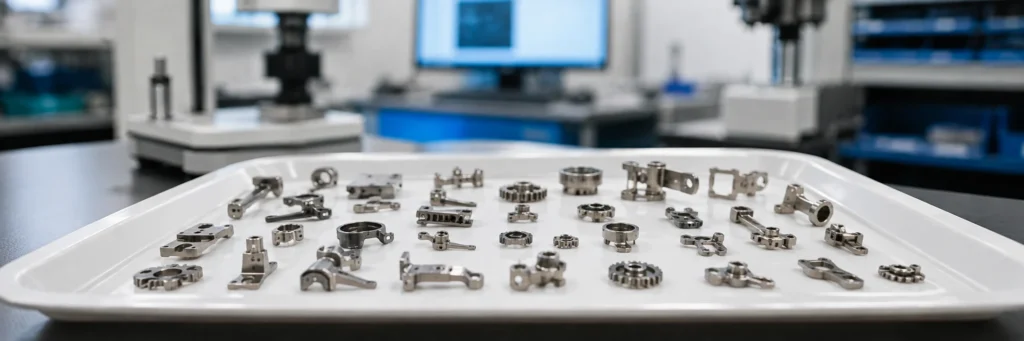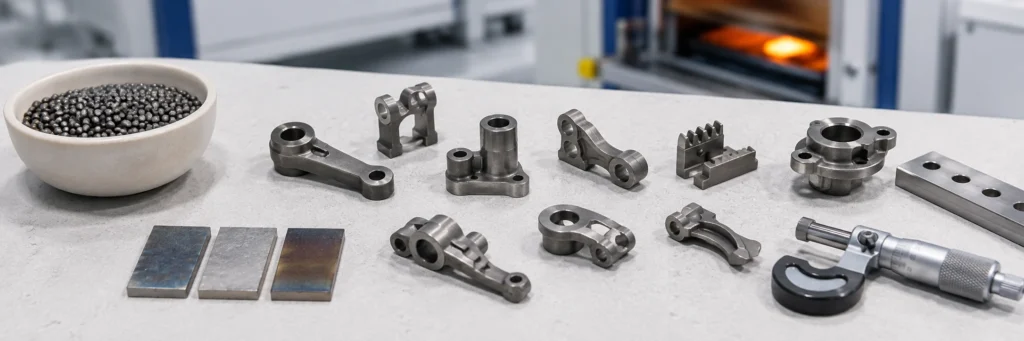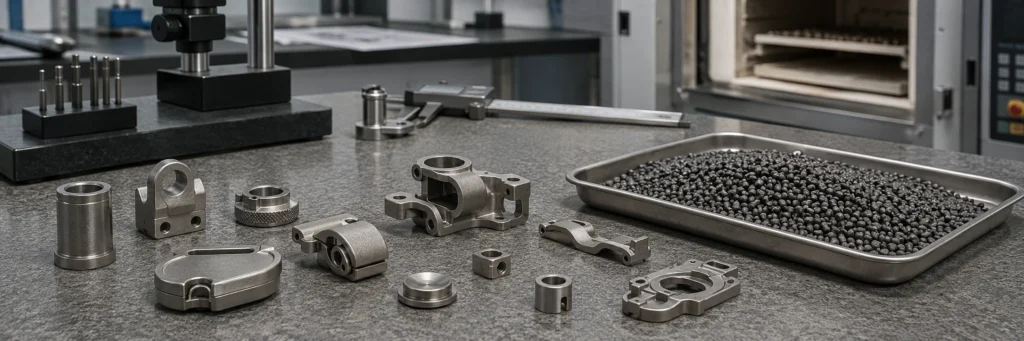
MIM Drawing & DFM Questions A useful MIM feasibility review needs more than a 3D CAD file. The CAD model shows the part shape, but the controlled 2D drawing tells the supplier what must function, what must be inspected, which surfaces cannot accept process marks, and which dimensions drive assembly or performance. For metal injection …

A useful MIM feasibility review needs more than a 3D CAD file. The CAD model shows the part shape, but the controlled 2D drawing tells the supplier what must function, what must be inspected, which surfaces cannot accept process marks, and which dimensions drive assembly or performance. For metal injection molding, this matters because the final part is influenced by feedstock flow, green part handling, debinding, sintering shrinkage, tooling compensation, secondary operations, and inspection strategy. If the drawing does not identify critical dimensions, datums, functional holes, cosmetic surfaces, material expectations, surface finish, and inspection requirements, the supplier may quote from assumptions instead of engineering intent. This page explains which drawing details engineers should mark before sending a MIM part for feasibility review, DFM discussion, or RFQ preparation.
Drawing not finalized?
Start with feasibility and DFM review before tooling discussion.
Critical dimensions unclear?
Mark function, datum references, and inspection expectations first.
Ready for pricing?
Prepare a complete RFQ package after drawing assumptions are clear.
Quick Answer: What Drawing Details Are Needed for a MIM Feasibility Review?
For a MIM feasibility review, the supplier needs to know more than the outside shape. The drawing should clarify which features control function, which surfaces are cosmetic or functional, what material condition is expected, whether secondary operations are allowed, and how the part will be inspected.

The drawing should show engineering priorities, not just overall part shape. These details help the MIM engineer evaluate tooling, shrinkage, secondary operations, and inspection assumptions.
| Drawing detail | Why it matters in MIM feasibility review | What to mark on the drawing |
|---|---|---|
| Critical dimensions | Determines whether the feature may be controlled as-sintered or may need sizing, machining, or tighter inspection. | CTQ dimensions, assembly dimensions, functional tolerances. |
| Datum structure | Defines how the part should be measured and assembled. | Primary, secondary, and tertiary datums. |
| Functional holes and slots | Affects core pin design, molding release, sintering distortion, and post-machining decisions. | Hole function, fit, depth, thread, and inspection method. |
| Cosmetic or visible surfaces | Helps the tooling review avoid gate marks, ejector marks, parting lines, or support marks on unacceptable surfaces. | Visible side, no-gate surface, no-ejector surface, and cosmetic zones. |
| Mating or sealing faces | Affects flatness, surface finish, and machining allowance decisions. | Contact zone, sealing face, flatness need, and functional surface requirement. |
| Material grade | Affects feedstock selection, sintering behavior, corrosion resistance, strength, magnetic response, and cost. | Specific alloy grade or application requirement. |
| Surface finish | Determines whether as-sintered surface is acceptable or finishing is required. | Ra target, polishing, blasting, passivation, coating, or PVD requirements. |
| Secondary operations | Changes cost, tolerance strategy, and delivered condition. | Machining, tapping, heat treatment, coating, polishing, or sizing expectations. |
| Inspection requirements | Defines quote scope and acceptance expectations. | CMM, gauge, visual criteria, sample report, or FAI requirement. |
| Estimated annual volume | Helps judge whether MIM tooling investment is economically reasonable. | Expected annual usage or production range. |
A common mistake is sending only a STEP file and asking whether the part can be made by MIM. In practice, the supplier can review the shape, but cannot reliably judge cost, risk, inspection scope, or delivered condition without drawing intent. For the broader project input package, use the MIM RFQ preparation guide. For design route navigation, see the MIM Design Guide.
Why a 3D CAD File Alone Is Not Enough for MIM Review
A 3D CAD file is useful because it shows part geometry, volume, undercuts, wall transitions, holes, and general complexity. However, a CAD file does not explain engineering priority. It does not tell the supplier which dimensions control assembly, which surface is visible to the end user, which hole is load-bearing, or which tolerance is negotiable.

For MIM feasibility review, the CAD model and drawing should work together. Geometry alone cannot define critical features, surface restrictions, or inspection scope.
From a design review perspective, this difference is important. MIM parts are produced from fine metal powder and binder feedstock, molded into green parts, debound, and then sintered to achieve final density and size. During sintering, the part shrinks, and the mold must be designed with shrinkage compensation. If the drawing does not define functional features clearly, the mold design and tolerance strategy may be based on incomplete assumptions.
CAD shows geometry.
It helps the supplier see shape, wall transitions, undercuts, holes, and approximate volume.
It helps the supplier see shape, wall transitions, undercuts, holes, and approximate volume.
Drawing shows intent.
It defines critical dimensions, datums, controlled surfaces, material notes, and inspection scope.
It defines critical dimensions, datums, controlled surfaces, material notes, and inspection scope.
Function drives tolerance.
Two similar dimensions may need different tolerance strategies depending on assembly function.
Two similar dimensions may need different tolerance strategies depending on assembly function.
Surface notes guide tooling review.
Visible, mating, sealing, or no-mark surfaces should be known before mold design.
Visible, mating, sealing, or no-mark surfaces should be known before mold design.
What XTMIM Reviews From Your Drawing
When a drawing is submitted for early review, the goal is not only to check whether the part shape can be molded. The engineering review looks for assumptions that may affect tooling, sintering behavior, dimensional control, secondary operations, inspection scope, and RFQ readiness.
Geometry risk
Wall transitions, thin sections, small features, undercuts, and difficult-to-fill areas are reviewed before tooling discussion.
Wall transitions, thin sections, small features, undercuts, and difficult-to-fill areas are reviewed before tooling discussion.
Mold release and ejection
Potential release direction, stable ejection surfaces, and no-mark areas are checked against the part function.
Potential release direction, stable ejection surfaces, and no-mark areas are checked against the part function.
Critical dimensions and datums
Assembly-critical features, datum logic, and inspection references are reviewed before tolerance assumptions are made.
Assembly-critical features, datum logic, and inspection references are reviewed before tolerance assumptions are made.
Surface restrictions
Visible, mating, sealing, coating, no-gate, and no-ejector surfaces are checked before tooling layout is discussed.
Visible, mating, sealing, coating, no-gate, and no-ejector surfaces are checked before tooling layout is discussed.
Sintering and distortion risk
Unsupported geometry, uneven sections, flatness needs, and possible support requirements are reviewed from a sintering perspective.
Unsupported geometry, uneven sections, flatness needs, and possible support requirements are reviewed from a sintering perspective.
Secondary operation needs
Features that may need machining, tapping, sizing, polishing, passivation, coating, or PVD are identified before quote scope is fixed.
Features that may need machining, tapping, sizing, polishing, passivation, coating, or PVD are identified before quote scope is fixed.
Inspection assumptions
CTQ features, CMM needs, gauge concepts, visual criteria, and report expectations are checked for quote and sample review alignment.
CTQ features, CMM needs, gauge concepts, visual criteria, and report expectations are checked for quote and sample review alignment.
RFQ readiness
The review helps decide whether the project is ready for formal RFQ or still needs drawing clarification.
The review helps decide whether the project is ready for formal RFQ or still needs drawing clarification.
For project-level review workflow, see XTMIM engineering review capability. The real question is not whether CAD is useful. It is whether the CAD file and drawing together explain the part’s function clearly enough for a manufacturing decision. For broader design review topics, review DFM for MIM before tooling.
Drawing Details That Directly Change MIM Feasibility
Some drawing details only clarify documentation. Others directly change the MIM manufacturing route. These details may affect tooling complexity, shrinkage compensation, sintering support, secondary operations, inspection cost, and final part acceptance.
| Drawing detail | What the MIM engineer checks | Possible feasibility decision |
|---|---|---|
| Tight functional tolerance | Can the dimension be controlled as-sintered, or does it need sizing or machining? | Accept as-sintered, adjust tolerance, add secondary operation. |
| Thin wall or wall transition | Will feedstock fill properly? Will the green part survive handling? Will debinding or sintering cause distortion? | Increase wall, add radius, modify transition, or review support strategy. |
| Deep hole or narrow slot | Can the core pin survive molding? Can the feature be measured? | Mold feature, redesign feature, or machine after sintering. |
| Undercut | Is slide, lifter, or side action required? Is the cost justified by part function? | Accept tooling complexity, simplify design, or use secondary operation. |
| Cosmetic surface | Can gate, parting line, ejector mark, or support mark be avoided? | Change tooling strategy, protect surface, or revise part orientation. |
| Thread | Is molded thread realistic, or should it be tapped after sintering? | Post-machine thread, redesign thread, or review strength need. |
| Flatness or perpendicularity | Can the requirement be achieved after sintering? Is machining allowance needed? | Review tolerance, add support, or machine critical surface. |
| Surface finish | Is as-sintered condition acceptable? Is polishing, blasting, passivation, or coating needed? | Add finishing step, define masking, or adjust quote scope. |
| Inspection requirement | Can the feature be measured consistently? Is CMM, gauge, or visual inspection required? | Define inspection method, revise datum, or clarify acceptance. |
MIM can produce complex small metal parts, but complexity still needs review. Features such as holes, slots, undercuts, thin walls, and side actions may reduce assembly or machining steps, but they can also increase tooling and engineering work. MIMA’s design resources note that complex MIM features may involve slides, cores, and similar tooling methods, and these features can add tooling and start-up engineering costs. MIMA Complex Designs with MIM
For tooling-related project review, see XTMIM MIM tooling capability.
Critical Dimensions Should Be Marked by Function, Not by Habit
Not every dimension on a MIM drawing should be treated as equally critical. A common RFQ problem is that the drawing applies tight tolerances across many features without explaining which ones actually affect assembly or performance. This can lead to overestimated cost, unnecessary inspection scope, or unrealistic expectations for as-sintered dimensions.
| Dimension type | Typical engineering meaning | Review focus |
|---|---|---|
| Assembly-critical dimension | Controls fit with mating parts. | Tolerance, datum, inspection method. |
| Functional hole or slot | Controls pin fit, shaft fit, flow path, or fastening. | Core pin feasibility, machining need, gauge access. |
| Cosmetic dimension | Affects appearance but not fit. | General tolerance and visual criteria. |
| Reference dimension | Supports understanding but is not controlled. | Avoid unnecessary inspection. |
| Machining-critical dimension | Must be finished after sintering. | Machining allowance, clamping, datum control. |
| As-sintered dimension | Can remain in molded and sintered condition. | Shrinkage control, process capability, inspection sampling. |
The best drawing does not simply add more tolerances. It tells the supplier which features deserve control and why. For example, if two holes control assembly alignment, those holes should be marked with datum references and inspection expectations. Other non-functional dimensions may remain under general tolerance.
This matters because MIM dimensional control depends on material, geometry, tooling, green part stability, debinding, sintering support, and inspection method. A tolerance that is reasonable on one feature may be difficult on another feature with different wall thickness, location, orientation, or sintering behavior. For a deeper tolerance discussion, review the MIM tolerance strategy page.
Functional Surfaces, Cosmetic Areas, and Gate / Ejector Restrictions
A MIM drawing should identify surfaces that cannot accept gate marks, ejector marks, parting lines, polishing variation, or sintering support marks. These notes are often more useful than generic cosmetic wording because they affect tooling review before the mold is built.

This image shows customer-defined restriction zones, not final gate or ejector design. Actual gate and ejector layout must be determined by the MIM tooling engineer based on part geometry, mold structure, filling balance, ejection stability, green part strength, and surface requirements.
Important surfaces to mark include visible exterior surfaces, customer-facing cosmetic surfaces, sealing faces, sliding or contact surfaces, mating faces, bearing or pivot areas, surfaces that require coating or passivation, areas where gate marks are not acceptable, areas where ejector marks are not acceptable, and surfaces that must remain flat after sintering.
Engineering note: The drawing should not attempt to replace mold design. It should communicate surface restrictions clearly enough for the MIM tooling engineer to choose a suitable gate, parting line, ejection, and support strategy.
In production, the gate location affects feedstock flow and filling balance. Ejector design affects green part release. Parting line location affects both appearance and function. If these restrictions are not shown on the drawing, the supplier may choose a tooling strategy that is manufacturable but not acceptable for the final product surface.
Composite field scenario for engineering training: cosmetic surface rejection
- What problem occurred
- A small MIM housing passed dimensional inspection but was rejected because a visible surface showed an unacceptable process mark.
- Why it happened
- The drawing showed external dimensions but did not identify the visible surface or no-mark zone.
- What the real system cause was
- The tooling review optimized manufacturability, but the customer’s cosmetic requirement was not communicated before tooling decisions.
- How it was corrected
- The drawing was updated to identify visible surfaces, no-gate surfaces, no-ejector surfaces, and acceptable non-cosmetic regions.
- How to prevent recurrence
- Mark cosmetic surfaces and unacceptable process-mark zones before mold design starts. Do not leave appearance requirements to verbal discussion.
For more context on molded part formation, review the MIM injection molding process.
Holes, Threads, Thin Walls, Undercuts, and Small Features Need Clear Functional Notes
Complex features are often the reason engineers consider MIM. However, the drawing should explain which features are functionally required and which can be modified for manufacturability.
Holes and Slots
Holes and slots should be marked by function, not only by size. A supplier needs to know whether a hole is used for assembly, location, fluid passage, weight reduction, fastening, or cosmetic alignment. Deep holes, blind holes, very small holes, and long narrow slots may create molding, tooling, debinding, sintering, or inspection challenges.
If the hole is critical, mark its tolerance, datum relationship, depth, inspection method, and whether post-machining is acceptable.
Threads
Functional threads often require special review. Some thread forms may be difficult to mold directly, especially when strength, repeatability, depth, or assembly reliability is important. In many production projects, tapping or thread finishing after sintering may be more realistic than relying on a fully molded thread.
The drawing should identify thread type, depth, fit requirement, assembly load, and whether secondary tapping is allowed.
Thin Walls
Thin walls can help reduce weight and material use, but they may affect feedstock filling, green strength, debinding stability, and sintering distortion. A thin wall that appears simple in CAD may become risky if it connects to a heavy section or unsupported geometry.
Mark whether the thin wall is functionally necessary. If there is room for adjustment, note whether wall thickening, radius addition, or geometry transition changes are acceptable.
Undercuts
Undercuts may be possible with side action or special tooling, but the design should justify the added complexity. If an undercut only provides minor appearance value, it may not deserve tooling cost. If it eliminates assembly or secondary machining, it may be worth reviewing.
The drawing should explain the function of the undercut and whether redesign is acceptable.
Micro Features
Small features should be reviewed for both manufacturability and inspection. A feature that can be modeled in CAD may still be difficult to mold, debind, sinter, or measure consistently. The drawing should identify whether the micro feature is functional, cosmetic, or optional.
Composite field scenario for engineering training: small hole assumption
- What problem occurred
- A small transverse hole was included in the CAD model, but its function was not explained. During review, the supplier assumed it was a non-critical molded feature.
- Why it happened
- The 2D drawing did not define the hole as an alignment feature or specify inspection requirements.
- What the real system cause was
- The design intent was missing. The supplier reviewed geometry, but not the functional role of the hole.
- How it was corrected
- The drawing was revised to mark the hole as an assembly-critical location feature with datum references and inspection method.
- How to prevent recurrence
- For holes, slots, and micro features, mark function, tolerance, datum relationship, and whether secondary machining is acceptable.
For broader design guidance, see the MIM Design Guide.
Material, Heat Treatment, and Surface Finish Notes Should Not Be Left Ambiguous
A drawing that only says “stainless steel” or “black finish” is usually not enough for MIM feasibility review. Material and finish assumptions affect feedstock selection, sintering route, secondary operations, corrosion resistance, hardness, magnetic behavior, and quote scope.
Material grade
Use a specific alloy grade when known, such as 316L, 17-4PH, 420, Fe-Ni alloy, or soft magnetic alloy.
Use a specific alloy grade when known, such as 316L, 17-4PH, 420, Fe-Ni alloy, or soft magnetic alloy.
Application environment
If material is not fixed, explain corrosion, wear, hardness, magnetic, or temperature requirements.
If material is not fixed, explain corrosion, wear, hardness, magnetic, or temperature requirements.
Delivery condition
Define whether the part should be as-sintered, machined, heat-treated, polished, passivated, coated, or PVD finished.
Define whether the part should be as-sintered, machined, heat-treated, polished, passivated, coated, or PVD finished.
Surface restrictions
Identify masking requirements and functional surfaces where finish matters.
Identify masking requirements and functional surfaces where finish matters.
Material selection should not be treated as a label only. MIM materials differ in powder chemistry, sintering behavior, achievable properties, corrosion behavior, heat treatment response, and surface finishing compatibility. MPIF notes that Standard 35-MIM covers common materials used in metal injection molding with explanatory notes and definitions. MPIF Standards
For material-specific review, see MIM materials. For machining, polishing, passivation, coating, and other delivered-condition topics, see MIM secondary operations.
Inspection Requirements Should Be Defined Before the Supplier Quotes the Part
Inspection requirements affect both feasibility review and quotation scope. If the drawing does not define how critical features will be inspected, two suppliers may quote the same part with different assumptions.

Critical dimensions, datum references, and inspection methods should be aligned before tooling review or formal quotation.
Important inspection-related drawing details include critical-to-quality dimensions, datum structure, CMM inspection requirements, functional gauge requirements, visual inspection criteria, surface defect limits, flatness, perpendicularity, concentricity, position requirements, sample report expectations, first article inspection expectations, and cosmetic acceptance limits.
A common mistake is defining tight tolerances but not defining the datum or inspection method. This can create disagreement after samples are produced. The part may appear to meet the CAD model, but fail the customer’s functional check because the supplier and customer measured from different references.
Composite field scenario for engineering training: inspection disagreement
- What problem occurred
- A MIM part was considered acceptable by the supplier but rejected by the customer during assembly testing.
- Why it happened
- The critical distance between two holes was measured from different datum assumptions.
- What the real system cause was
- The drawing did not define the datum structure or inspection method for the functional hole pattern.
- How it was corrected
- The drawing was updated with datum references, position control, and inspection notes for the hole pattern.
- How to prevent recurrence
- Mark critical features together with datums and inspection methods before quoting or tooling review.
For supplier evaluation and measurement support, review MIM inspection and testing capability.
What Information Belongs Outside the Drawing but Should Still Be Sent?
Some information does not belong directly on the drawing, but it still affects MIM feasibility and quote accuracy. This section should not replace a formal RFQ checklist. It explains why drawing review and project context should be sent together.
| Information outside the drawing | Why it matters |
|---|---|
| Estimated annual volume | Helps judge whether MIM tooling cost is economically reasonable. |
| Current manufacturing process | Helps compare MIM with CNC, casting, stamping, or metal 3D printing. |
| Application background | Helps review material, surface finish, strength, corrosion, and wear needs. |
| Mating parts | Helps judge functional dimensions and assembly risks. |
| Project stage | Helps decide whether design review or formal RFQ is more appropriate. |
| Target production condition | Helps define as-sintered, machined, heat-treated, or coated delivery. |
| Known failure history | Helps identify risk areas before tooling. |
MIMA’s design guidance frames MIM review around material choice, production quantity, shape complexity, and cost-effectiveness. MIMA Designing with MIM For a complete project input package, use the MIM RFQ preparation guide.
When to Request a Drawing Review Instead of a Formal RFQ
A drawing review and a formal RFQ are related, but they are not the same step. If the design is still flexible, early drawing review is usually more useful than asking for a final price. If the drawing is released and project requirements are clear, a formal RFQ can be more accurate.
| Project status | Better next step | Why |
|---|---|---|
| Drawing is not finalized | Submit drawing for feasibility review | Design risks can be found before tooling. |
| Material is not confirmed | Request material suitability review | Avoid wrong alloy or heat treatment assumptions. |
| Tolerances are uncertain | Request tolerance review | Decide as-sintered, sizing, or machining strategy. |
| Cosmetic surfaces are unclear | Request tooling and surface review | Avoid gate, ejector, parting line, or support mark conflicts. |
| Drawing, material, volume, and finish are complete | Request a formal quote | Supplier can evaluate cost and production route more accurately. |
| Multi-part OEM project | Request project-level engineering review | Several parts may need shared material, tolerance, and production planning. |
If the part is still in design validation, submit the 2D drawing, 3D CAD file, material expectation, critical dimensions, annual volume estimate, and application background for feasibility review. If the drawing package is already complete, prepare a formal RFQ package.
Submit Your Drawing for MIM Feasibility Review
If your part has small complex geometry, functional holes, tight assembly dimensions, cosmetic surface requirements, or uncertain material selection, an early MIM feasibility review can help identify manufacturing risks before tooling discussion.
- 2D drawing and 3D CAD file
- Material requirement or application environment
- Critical dimensions and datum information
- Surface finish and cosmetic requirements
- Secondary operation expectations
- Estimated annual volume
- Inspection or acceptance requirements
FAQ: MIM Drawing Details for Feasibility Review
Is a 3D CAD file enough for a MIM feasibility review?
A 3D CAD file is helpful, but it is not enough for a reliable MIM feasibility review. The supplier also needs a controlled 2D drawing or clear engineering notes that define critical dimensions, datums, functional surfaces, cosmetic restrictions, material expectations, surface finish, secondary operations, and inspection requirements.
What if my MIM drawing is incomplete?
You can still submit an early drawing or 3D CAD file for preliminary feasibility review, but mark any known critical dimensions, material expectations, functional surfaces, project stage, and annual volume estimate. In that case, the supplier may provide manufacturability comments and risk feedback rather than a final quote.
Do I need a fully released 2D drawing before contacting a MIM supplier?
Not always. If the design is still flexible, an early drawing or preliminary drawing can still be useful for feasibility review. However, the drawing should clearly show functional features, critical areas, and any non-negotiable requirements. A fully released drawing is more important when asking for a formal quote.
Which dimensions should be marked as critical for MIM?
Critical dimensions are usually the dimensions that affect assembly, movement, sealing, alignment, fastening, or safety-related performance. They should be marked with datum references and inspection expectations. Dimensions that are not function-critical should not be over-controlled without reason.
Should cosmetic surfaces be marked on the drawing?
Yes. Cosmetic and visible surfaces should be marked before tooling review. Gate marks, ejector marks, parting lines, and support marks may be acceptable on some surfaces but unacceptable on customer-facing or functional surfaces.
Can a MIM supplier review a part before material selection is finalized?
Yes, but the application requirements should be explained. If the exact alloy is not fixed, provide corrosion, strength, hardness, magnetic, wear, or temperature requirements so the supplier can suggest a realistic material direction for MIM review.
What is the difference between drawing review and formal RFQ?
Drawing review focuses on manufacturability, tooling risk, tolerance strategy, material assumptions, and potential design changes. A formal RFQ focuses on price, lead time, production scope, and commercial terms based on a more complete drawing and project package.
What drawing details most often cause wrong supplier assumptions?
The most common missing details are critical dimensions, datum structure, cosmetic surfaces, functional holes, secondary operations, surface finish, and inspection requirements. When these are missing, suppliers may quote the same part with different assumptions.
Standards and Technical Reference Note
MIM drawing review should be based on the project drawing, material requirement, geometry, tolerance strategy, inspection plan, and supplier-specific process capability. Industry references can support evaluation, but they should not replace project-specific DFM review.
These references support design and material discussion. Final acceptance requirements should be defined by the drawing, project specification, material datasheet, agreed inspection plan, and applicable customer or industry requirements.
- MIMA Design Center — Designing with MIM: relevant for understanding why material, production quantity, shape complexity, and cost affect feasibility review.
- MIMA Design Center — Complex Designs with MIM: relevant for holes, undercuts, cores, slides, and tooling-complexity discussions.
- MPIF Standards — Standard 35-MIM: relevant for material specification discussions for metal injection molded parts.