MIM Process Selection Insights Metal 3D printing is useful for small metal prototypes, design validation, low-volume orders, and geometries that are difficult to make with tooling. The decision changes when the part becomes stable, repeats in predictable quantities, and must meet production cost, dimensional, surface, and inspection requirements over many batches. In that situation, Metal …
Metal 3D printing is useful for small metal prototypes, design validation, low-volume orders, and geometries that are difficult to make with tooling. The decision changes when the part becomes stable, repeats in predictable quantities, and must meet production cost, dimensional, surface, and inspection requirements over many batches. In that situation, Metal Injection Molding (MIM) is often worth reviewing because the shape-making work can shift from repeated layer-by-layer builds to a tooling-based route with injection molding, debinding, sintering, and controlled secondary operations. The key question is not whether MIM or metal 3D printing is more advanced. The real question is whether the part is small, repeatable, moldable, material-compatible, and stable enough to justify MIM tooling and production validation.
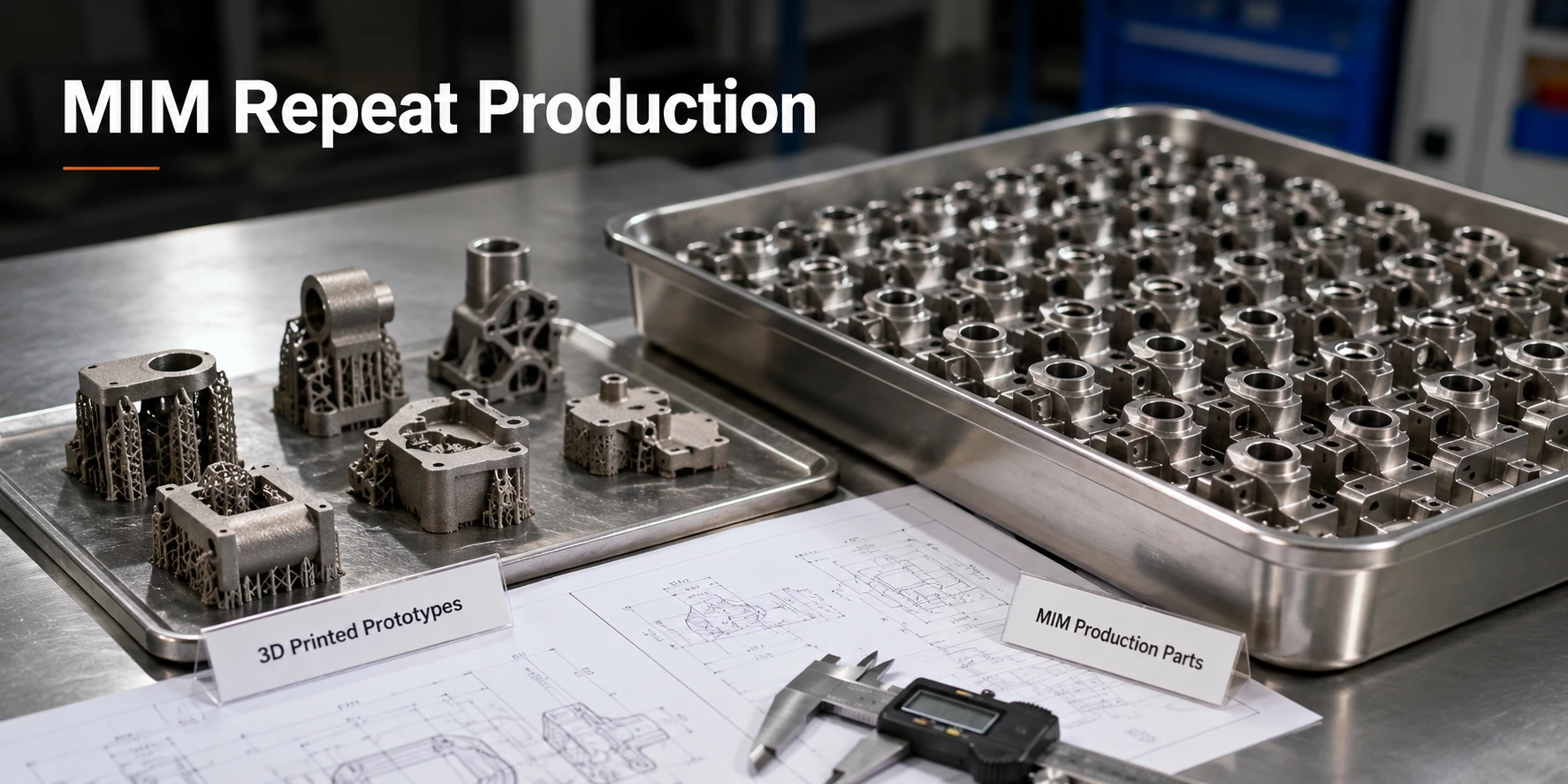
Core conclusion: A printed metal sample can validate function, but repeat production still needs a separate review of moldability, material, tolerance, tooling risk, and inspection planning.
For a broader process-level comparison, see XTMIM’s full process comparison between MIM and metal AM. This article focuses more narrowly on small metal parts that have moved beyond prototype testing and now need repeatable production.
Quick Answer: When Should Small Parts Move from Metal 3D Printing to MIM?
Small metal parts are usually worth reviewing for MIM when the printed prototype has already proven the function, the design is close to frozen, and the buyer now needs repeatable production instead of more prototype learning. In that stage, MIM can be stronger than metal 3D printing when the part is small, externally complex, moldable, material-compatible, and produced in predictable batches where tooling cost can be amortized.
Metal 3D printing should usually stay in the process route when the design still changes, quantity is very low, or the geometry depends on internal channels, lattice features, enclosed cavities, or other AM-specific structures. A successful printed sample is not enough evidence for MIM tooling. The part still needs review for mold release, gate location, wall balance, debinding path, sintering shrinkage, tolerance strategy, secondary operations, and inspection planning.
| Project condition | MIM is usually stronger when | Metal 3D printing is usually stronger when |
|---|---|---|
| Design status | Drawing is close to frozen and major geometry changes are unlikely | Design still changes frequently between prototype builds |
| Quantity | Repeat demand is predictable enough to review tooling amortization | Quantity is low, irregular, or custom by batch |
| Geometry | External complexity is moldable and can be supported through sintering | Internal channels, lattice, or AM-only geometry are required |
| Cost target | Long-term unit cost and batch stability matter more than tooling avoidance | Tooling avoidance and fast design iteration matter more |
| Quality control | Batch repeatability, inspection planning, and controlled finishing are needed | Fast functional samples are the main requirement |
| Project stage | Production route is being selected before tooling or scale-up | Prototype learning is still active |
For the broader process boundary, compare MIM vs metal 3D printing. For drawing-level manufacturability, use a MIM DFM review. If the production concern is dimensional control, finishing, or acceptance criteria, connect the review with inspection and testing requirements before requesting a quote.
A common mistake: comparing a 3D printed prototype quote directly against a MIM production quote. Those two quotes usually answer different questions. A prototype quote asks, “Can we test this part quickly?” A MIM production review asks, “Can this part be manufactured repeatedly with stable cost, controlled shrinkage, acceptable tolerances, and practical inspection?”
Do Not Move to MIM Yet If These Risks Are Still Open
A printed sample can be useful evidence, but it is not enough to open MIM tooling. Before moving a small metal part into MIM review, the design team should first confirm that the project has moved beyond prototype learning and that the production route can be reviewed from a drawing, material, tolerance, and volume perspective.
The design is still changing
Frequent CAD revisions can make MIM tooling risky because geometry changes after tooling may require mold modification or redevelopment.
The geometry depends on AM-only features
Internal channels, closed cavities, lattice structures, or topology-optimized shapes may need redesign before MIM moldability can be reviewed.
The alloy or property target is not confirmed
A metal AM alloy choice should be checked against available MIM feedstock options, sintering behavior, heat treatment needs, and application requirements.
The drawing lacks critical dimensions
MIM review needs defined functional interfaces, tolerances, datums, inspection points, and surface expectations before a production route can be judged.
If the printed prototype is stable, annual demand is becoming predictable, and the critical dimensions are clear, the next step is usually a MIM DFM review before tooling, not only a unit-price comparison.
Are You Comparing Prototype Price or Repeat-Production Cost?
The cost logic changes once a small metal part moves from prototype testing into repeat production. Metal 3D printing avoids mold cost, which makes it attractive for early samples and small batches. However, repeated metal additive manufacturing production may still carry cost from build time, support removal, heat treatment, surface finishing, machining, inspection, and batch qualification.
MIM works differently. The project usually requires tooling, DFM review, trial molding, debinding validation, sintering control, and dimensional adjustment before stable production. This makes MIM less attractive for unstable designs or very low quantities. But when the design is stable and the part repeats, tooling cost can be spread across production volume. The part can then be made through feedstock injection molding, debinding, sintering, and planned finishing rather than repeatedly building each part layer by layer.
| Cost driver | Metal 3D printing | MIM |
|---|---|---|
| Upfront cost | Usually lower because no mold is required | Higher because tooling, trial molding, and process adjustment are required |
| Unit cost at repeat volume | Often limited by build time, nesting efficiency, support removal, and finishing | Can improve when tooling cost is amortized and the process is stabilized |
| Design changes | Easier to revise between builds | More costly after tooling is made |
| Surface finishing | Often needs support removal, polishing, machining, blasting, or other post-processing | Depends on as-sintered surface, selective secondary operations, and cosmetic requirements |
| Inspection | May vary by AM route, build orientation, support location, and finishing route | Can be standardized after tooling, shrinkage, and process validation |
| Best-fit stage | Prototype, low-volume, changing design, or AM-specific geometry | Stable, repeatable, moldable small metal parts |

Core conclusion: Prototype pricing and repeat-production cost should be reviewed separately before selecting MIM or metal 3D printing.
The key point is not that MIM is always cheaper. MIM may not be economical for low-volume, large, simple, or unstable parts. It becomes more relevant when the current process has high repeated cost because every batch requires printing time, finishing, machining, and inspection, while the MIM route can convert much of the shape-making work into a repeatable tooling-based process. For a deeper cost discussion, review the MIM cost drivers page.
Why Small Parts Often Fit MIM Better Than Larger Metal Parts
Small parts are not automatically suitable for MIM, but they often create a stronger MIM business case than larger parts. MIM is most useful when a compact metal component combines small size, moldable external complexity, repeat demand, and material performance requirements. The part also needs enough design stability to justify tooling and enough process margin to survive green part handling, debinding, sintering shrinkage, and final inspection.
Multi-Cavity Tooling Can Change the Economics
For small repeat-production parts, multi-cavity tooling can significantly change the production logic. Instead of forming one part at a time through an additive build process, MIM can mold multiple green parts per cycle when the tool design, part geometry, material flow, gate location, shrinkage behavior, and project volume support it.
From a design review perspective, this does not mean every small part should use the maximum number of cavities. Tooling layout depends on part size, feedstock flow, gate location, shrinkage behavior, ejection risk, and dimensional control. If your part requires a more detailed tooling review, see XTMIM’s MIM mold design guidance.
Small Feature Density Matters More Than Simple Size

Core conclusion: Small MIM candidates often combine compact size, external feature density, and repeatable production demand.
A small block-shaped metal part with simple geometry may not justify MIM. A small part with dense external features may be a better candidate. Typical examples include ribs, bosses, slots, holes, side features, logos, mounting details, and compact functional surfaces.
MIM can be valuable when these features would otherwise require repeated CNC machining, assembly, welding, or post-processing after metal additive manufacturing. However, the features must still be moldable and sinterable. Thin walls, isolated thick sections, sharp transitions, weak features, and narrow blind areas may increase risk during filling, green part handling, debinding, sintering, or inspection. For more geometry review points, read the MIM part design guidelines.
Repeatability Becomes More Important Than Design Freedom
Metal 3D printing gives engineers flexibility during early development. That flexibility is useful when the product team is still testing function, assembly, weight reduction, or geometry. But after the design becomes stable, repeatability often becomes more important than design freedom.
In repeat production, the user usually cares about whether each batch meets critical dimensions, whether secondary operations are predictable, whether surface finish is controlled, and whether inspection can be standardized. This is where MIM may become the better production route for small moldable parts.
Where Metal 3D Printing Still Wins Before Repeat Production
A credible MIM supplier should not claim that every printed metal part should be converted to MIM. Metal 3D printing still has a clear role before repeat production and in some final-use production cases.
When the Design Is Still Changing
If the drawing is not frozen, MIM tooling can create unnecessary risk. A printed prototype can help confirm fit, function, assembly space, and early mechanical behavior before the project commits to tooling. If a team expects several rounds of design changes, metal 3D printing or CNC prototyping may be more practical.
When the Part Has AM-Only Geometry
Some geometries are suitable for metal 3D printing specifically because they do not need mold release. Internal channels, enclosed cavities, lattice structures, topology-optimized shapes, and certain porous structures may not be practical MIM candidates without redesign.
A printed part can be functionally successful and still be unsuitable for MIM. The design must be checked for parting line feasibility, core or slide requirements, ejection direction, gate location, debinding path, and sintering support. For a process overview, see XTMIM’s metal 3D printing overview for MIM buyers.
When Quantity Cannot Justify Tooling
For very low quantities or one-off production, avoiding tooling may matter more than reducing long-term unit cost. In that case, metal 3D printing can remain the better route even if MIM would theoretically make the part repeatable.
The decision should be based on project lifetime, expected design stability, annual volume, material, finishing requirements, and inspection burden, not only on the first order quantity.
Which 3D Printed Small Metal Parts Are Worth Reviewing for MIM Repeat Production?
A metal 3D printed small part is worth reviewing for MIM when the function has been validated, the geometry is close to stable, and the project now needs repeated production. The review should not start from the question, “Can MIM copy this printed part exactly?” It should start from, “Can this function be redesigned or confirmed for a moldable, debindable, sinterable, and inspectable MIM production route?”
| Review item | Good signal for MIM review | Risk signal |
|---|---|---|
| Geometry | External complexity with moldable features | Internal channels, closed cavities, lattice structures |
| Wall section | Relatively balanced wall thickness and no isolated thick mass | Heavy-to-thin transitions, sink-prone sections, or unsupported weak features |
| Tolerance | Critical dimensions can be separated from general features | Ultra-tight tolerance applied across many non-critical surfaces |
| Material | A practical MIM feedstock option exists | AM-only alloy choice or special printed microstructure requirement |
| Surface | Functional surfaces can be finished selectively | All surfaces require very smooth or cosmetic AM finish |
| Production volume | Repeat demand is predictable | One-off use or unstable forecast |
| Assembly function | Critical interfaces are defined | Function depends on uncontrolled surface or hidden internal features |
| Inspection | Key dimensions, datum strategy, and acceptance criteria are clear | No drawing control or no critical-to-function definition |

Core conclusion: A printed geometry may require redesign before it can be molded, debound, sintered, and inspected as a MIM part.
The most important engineering warning is simple: printable is not the same as moldable. AM-only internal features may be functionally successful but still unsuitable for direct MIM tooling without redesign. For a more complete review path, use a MIM DFM review before tooling.
Composite Field Scenario for Engineering Training: Printed Prototype, Unstable MIM Review
This scenario is a composite engineering training example, not a disclosed customer case.
What problem occurred
A small metal bracket was successfully tested as a metal 3D printed prototype. The buyer wanted to move it into MIM production because annual demand was expected to increase.
Why it happened
The printed part contained a closed internal pocket and several local thick sections that were not obvious from the external view.
System cause
The team treated functional prototype success as proof of production suitability.
How it was corrected
The closed pocket was redesigned into an accessible external feature, thick sections were adjusted, and critical dimensions were separated from non-critical surfaces.
Prevention
Before MIM tooling, printed prototypes should be reviewed for mold release, wall balance, gate location, shrinkage direction, sintering support, and inspection strategy.
Resulting MIM review decision
The part was not treated as a direct AM-to-MIM conversion. It was moved into a redesign-and-review path, with MIM considered only after the risky internal pocket, wall imbalance, and inspection strategy were clarified.
What Changes When a Small Part Moves from AM Prototype to MIM Production?
Moving from metal AM prototype to MIM production is not a direct copy-and-produce step. The prototype may confirm that the part works, but MIM production must confirm that the part can be made repeatedly through feedstock injection molding, green part handling, debinding, sintering, dimensional adjustment, and final inspection.

Core conclusion: Moving from metal AM prototype to MIM production requires DFM review, tooling validation, shrinkage planning, and repeat-production control.
The CAD May Need MIM-Oriented Redesign
The CAD model may need changes before tooling. Sharp internal transitions may need radii. Local thick masses may need adjustment. Some holes or slots may need direction review. Features that were easy to print may require mold slides, cores, or redesign for practical tooling.
This does not mean the product function must change. It means the manufacturing route must be considered before the design is frozen for tooling.
Material Availability Must Be Rechecked for MIM Feedstock
A material that worked in metal AM should not be assumed to transfer directly to MIM. The same nominal alloy family may have different availability, sintering behavior, heat treatment response, density expectations, surface condition, or inspection requirements when it is made through fine metal powder plus binder feedstock, injection molding, debinding, and sintering.
Before replacing AM with MIM, the material review should confirm whether a practical MIM feedstock option exists and whether the application requires corrosion resistance, wear resistance, magnetic behavior, strength, hardness, coating compatibility, or post-sintering heat treatment. For a focused explanation of why printed metal powder and MIM powder-binder feedstock should not be treated as the same material input, review MIM feedstock vs metal 3D printing powder. If material selection is still open, review the available MIM materials before finalizing tooling and tolerance assumptions.
Tolerances Should Be Split by Function
A common drawing mistake is to apply tight tolerances across many features because the printed prototype was manually finished or measured as a sample. In MIM, tolerance planning should distinguish between general molded/sintered features and critical functional interfaces.
Critical dimensions may need process capability review, inspection planning, or secondary operations. Non-critical surfaces should not carry unnecessary tight tolerances, because excessive tolerance requirements can increase cost and delay production validation. For more detail, review tolerance planning for sintered MIM parts.
Secondary Operations Should Be Planned Before Tooling
MIM can produce near-net-shape metal parts, but some features may still need machining, sizing, tapping, polishing, coating, heat treatment, or other secondary operations. These requirements should be discussed before tooling because they may affect datum strategy, stock allowance, fixture access, surface expectations, and inspection method.
For related finishing and post-processing options, see secondary operations for MIM parts.
Composite Field Scenario for Engineering Training: Prototype Surface vs Production Surface
This scenario is a composite engineering training example, not a disclosed customer case.
What problem occurred
A buyer approved a metal 3D printed prototype after manual polishing and light machining. Later, the same surface expectation was applied to a repeat-production MIM quote.
Why it happened
The team compared a finished prototype surface with an expected production surface without separating base process surface, finishing steps, and functional surface needs.
System cause
Surface requirements were not defined by function.
How it was corrected
The drawing was reviewed to identify critical surfaces. Only functional surfaces were planned for controlled finishing.
Prevention
When moving from AM prototype to MIM production, surface finish should be defined by function, not by the appearance of a hand-finished sample.
Resulting MIM review decision
The project was reviewed with separate requirements for as-sintered surfaces, functional surfaces, cosmetic areas, and any planned secondary operations instead of quoting every surface to a prototype-level finish.
Procurement Decision: Stay with Metal 3D Printing or Request a MIM Review?
For sourcing teams, the decision should not be framed as “Which process is cheaper?” A better question is: “Which route can support this part’s expected lifetime volume, quality requirements, and production stability?”
| Situation | Recommended action |
|---|---|
| Only a few parts are needed for testing | Stay with metal 3D printing, CNC, or another prototype route |
| Design changes are still expected | Do not open MIM tooling yet |
| Same small part repeats monthly or annually | Request MIM suitability review |
| AM unit cost remains high after demand grows | Compare lifetime cost with MIM |
| Printed parts require repeated support removal, polishing, machining, or inspection every batch | Review whether MIM plus planned secondary operations can reduce repeat-production burden |
| Part has internal channels or lattice | Keep AM or redesign before MIM review |
| Drawing is frozen and volume is predictable | Start MIM DFM and tooling-risk review |
| Critical dimensions are not defined | Clarify inspection and functional requirements before quoting |
| Material is not confirmed | Review MIM feedstock options and application conditions |
A purchasing decision based only on the first batch price can be misleading. A repeat-production decision should include tooling amortization, projected annual volume, finishing operations, inspection burden, scrap risk, engineering changes, and supplier communication cost.
If the part is already stable enough for supplier evaluation, you can request a MIM quote with drawings and annual volume, including CAD files, material requirements, tolerance expectations, surface finish needs, and estimated annual demand.
What Information Should You Send for a MIM Repeat-Production Review?
A useful MIM review needs more than a part name or photo. The engineering team needs enough information to judge whether the part is moldable, sinterable, inspectable, and commercially reasonable for repeat production.
2D drawing with dimensions, tolerances, datum references, and critical features
3D CAD file, preferably STEP or equivalent neutral format
Current metal 3D printing process if known
Current material grade or target material performance
Estimated annual volume and expected production life
Current cost pressure or reason for evaluating MIM
Surface finish requirements and cosmetic expectations
Critical dimensions and functional interfaces
Heat treatment, coating, machining, tapping, or polishing requirements
Assembly function and application environment
Current prototype test results, if available
Known failure points, deformation concerns, or inspection requirements
For early engineering review, use the submit your drawing for MIM review path. If you are preparing a complete sourcing package, the RFQ preparation guide can help organize the information before quotation.
Composite Field Scenario for Engineering Training: Missing Annual Volume
This scenario is a composite engineering training example, not a disclosed customer case.
What problem occurred
A sourcing team asked for a MIM quote based only on a 3D file and a sample image. The engineering team could not judge whether MIM was commercially suitable.
Why it happened
The buyer treated MIM as a direct manufacturing quote rather than a production-route review.
System cause
Annual volume, production life, material requirement, critical dimensions, and finishing expectations were missing.
How it was corrected
The buyer provided estimated annual volume, target material, functional surfaces, current prototype cost pressure, and required inspection points.
Prevention
For MIM repeat-production review, buyers should send both technical drawings and project context.
Resulting MIM review decision
The quote moved from a simple unit-price request to a production-route review, allowing tooling risk, material availability, inspection scope, and lifetime volume to be evaluated together.
FAQ: Small MIM Parts vs Metal 3D Printing in Repeat Production
Is MIM cheaper than metal 3D printing for small parts?
Not always. MIM is usually not the best route for very low quantities, unstable designs, or AM-only geometry. It becomes more relevant when the small part is repeatable, moldable, design-stable, and expected to run in predictable production volumes.
What production volume makes MIM better than metal 3D printing?
There is no universal number. The decision depends on part size, material, tooling complexity, secondary operations, inspection requirements, current AM cost, and expected project lifetime. A drawing-based review is more reliable than a fixed quantity rule.
Can metal 3D printing be used for repeat production instead of MIM?
Yes, metal 3D printing can be used for repeat production when the volume is low, the design changes often, or the part requires AM-specific geometry such as internal channels or lattice structures. For stable small parts with predictable demand, high repeated finishing cost, and moldable external features, a MIM review may be more appropriate.
Can a metal 3D printed prototype be moved directly to MIM?
Not automatically. A printed prototype may prove function, but MIM also requires moldability, feedstock flow, debinding, sintering shrinkage control, tolerance planning, and inspection review.
When should I keep using metal 3D printing?
Metal 3D printing may remain better when the design is still changing, quantity is very low, internal channels or lattice structures are required, or the part depends on AM-specific geometry that cannot be redesigned for tooling.
What small parts are usually good MIM candidates?
Good candidates are usually small, complex, repeatable, externally moldable metal parts with stable drawings, practical material choices, predictable annual volume, and defined critical dimensions.
What should I send for a MIM suitability review?
Send the 2D drawing, 3D CAD file, material requirement, tolerance needs, surface finish expectations, estimated annual volume, current AM process if known, prototype test results, and application background.
Does MIM eliminate all secondary operations?
No. MIM can reduce machining and assembly for suitable near-net-shape parts, but some projects still need sizing, machining, tapping, polishing, coating, heat treatment, or inspection-specific operations. These should be reviewed before tooling.
Review a Small Metal Part for MIM Repeat Production
If your small metal part has moved beyond prototype testing and now requires repeat production, XTMIM can review whether MIM is a practical production route. Send your 2D drawing, 3D CAD file, material requirement, tolerance needs, surface finish expectations, current metal 3D printing process, and estimated annual volume.
Our engineering review can help evaluate moldability, material suitability, tooling risk, debinding and sintering concerns, tolerance strategy, secondary operations, and inspection requirements before you commit to tooling, trial production, or repeat production.
Standards and Technical References Note
MIM and metal additive manufacturing decisions should be reviewed using process-specific engineering guidance rather than generic manufacturing claims. MIMA’s MIM design resources are relevant because they support early candidate evaluation for metal injection molded components, including how part size, shape complexity, material performance, production quantity, and component cost affect MIM suitability.
MPIF standards resources are relevant for communicating material and process requirements across powder metallurgy, MIM, and metal additive manufacturing projects. These resources can support specification discussions, but they do not replace project-specific drawing review, material data sheets, or supplier process capability validation.
NIST powder bed fusion resources are relevant for understanding why metal AM is a layer-by-layer manufacturing route and why AM may suit prototypes, low-volume production, and AM-specific geometries. Final material, tolerance, inspection, and production recommendations should still be confirmed through project-specific DFM review, formal purchase requirements, and supplier-specific process capability review.