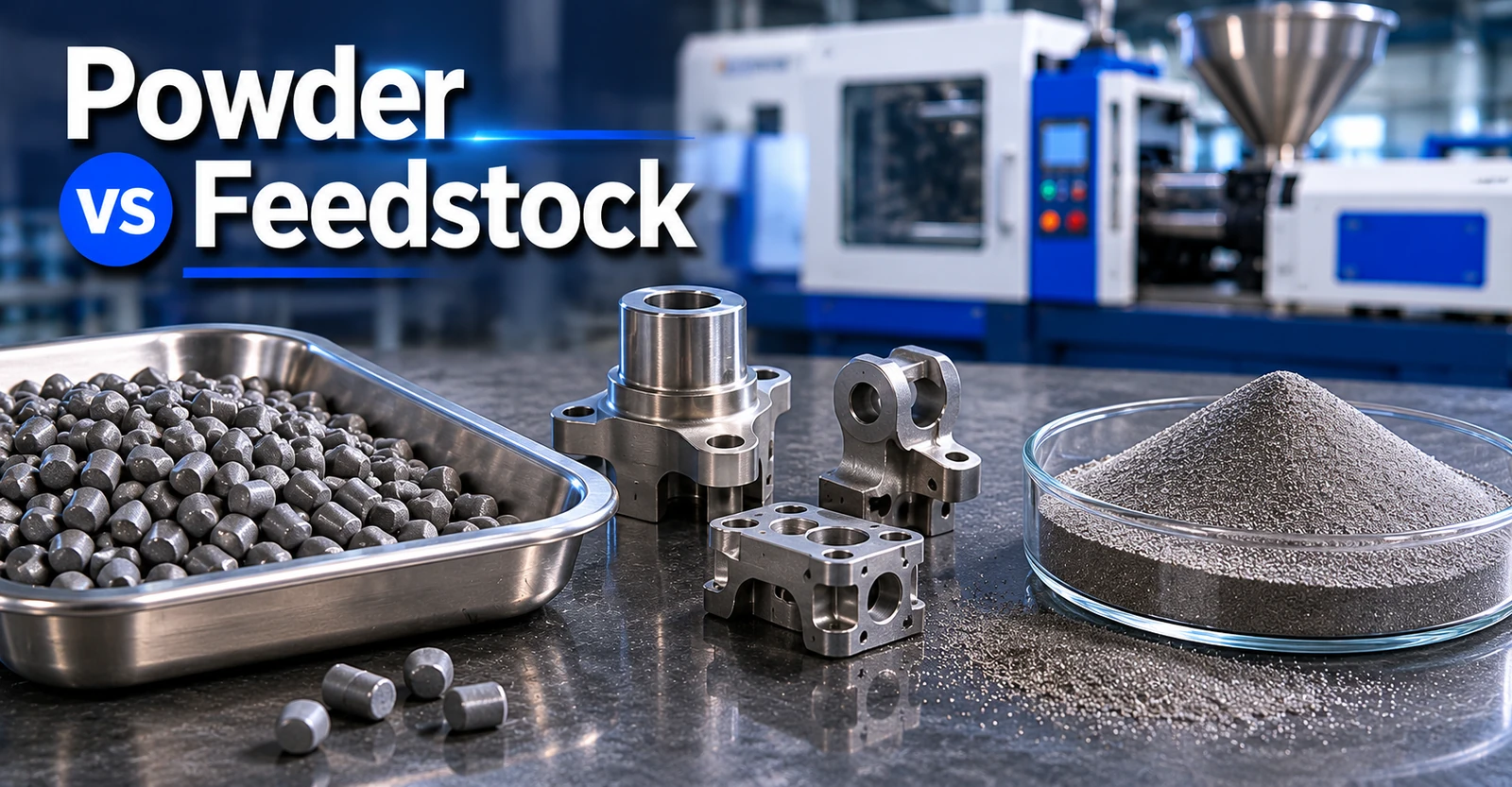
MIM feedstock is not the same as metal 3D printing powder. In MIM, fine metal powder is compounded with a binder system into moldable feedstock pellets before injection molding, debinding and sintering. Metal 3D printing uses route-specific additive material inputs, such as LPBF powder, binder jetting powder, DED feedstock or bound-metal extrusion material. For engineers …
MIM feedstock is not the same as metal 3D printing powder. In MIM, fine metal powder is compounded with a binder system into moldable feedstock pellets before injection molding, debinding and sintering. Metal 3D printing uses route-specific additive material inputs, such as LPBF powder, binder jetting powder, DED feedstock or bound-metal extrusion material. For engineers comparing MIM with metal AM, the key decision is whether the powder route, binder behavior, shrinkage control, density expectation, surface condition and inspection plan fit the final production requirement.
From a design review perspective, the real issue is not only whether both routes can use 316L or 17-4 PH. The practical question is whether the powder route, binder behavior, shrinkage control, density expectation, surface condition, cost target and inspection plan match the production goal. A metal 3D printed prototype can help validate shape or function before MIM tooling, but it cannot automatically prove that the same design is moldable, debindable, sinterable, or suitable for repeatable MIM production. For complete process-level selection, use the full MIM and metal 3D printing process comparison guide; this page focuses on powder, feedstock and material-route differences.
Core conclusion:
The key engineering question is not whether both processes use metal powder, but whether the material input, forming route, sintering or thermal history, and inspection plan fit the production requirement.
Quick answer: Use MIM feedstock review when the part is small, complex, stable in design, and intended for repeatable production through tooling. Use metal 3D printing powder review when the design is still changing, volume is low, or the geometry depends on AM-specific features such as internal channels, lattice structures or tool-less iteration. A printed prototype can support early validation, but it does not replace MIM review of feedstock behavior, moldability, debinding, sintering shrinkage, tolerance strategy, surface condition and inspection acceptance.
Material input
MIM begins with powder-binder feedstock pellets, not loose powder alone.
Process route
Metal AM powder behavior depends on LPBF, binder jetting, DED, or bound-metal extrusion routes.
Production review
Printed prototype success does not replace MIM DFM, shrinkage, tooling, and inspection review.
Are MIM Feedstock and Metal 3D Printing Powder the Same Thing?
No. MIM feedstock and metal 3D printing powder should not be treated as the same material input.
In MIM, metal powder is only one part of the starting material. The powder is mixed with a binder system and processed into feedstock pellets that can flow through an injection molding machine. The binder gives the powder moldability and green-part strength, but it must later be removed during debinding before the metal particles densify during sintering. This connects feedstock selection directly with the broader MIM process route, not only raw material purchasing.
In metal 3D printing, the material input depends on the additive route. Laser powder bed fusion uses loose metal powder spread in layers and selectively melted. Binder jetting uses powder bed deposition with a liquid binder before debinding and sintering. Bound metal extrusion may use metal powder in a polymer-bound form, but it still follows an additive build route rather than a mold-cavity injection route.
A common mistake is to compare “MIM powder” and “3D printing powder” only by alloy name. From a design review perspective, the better comparison is process route: how the material flows, how the shape is formed, how binder or heat is used, how the part densifies, and how final dimensions are controlled.

Core conclusion:
Identify the material input and forming route before comparing final part performance.
| Comparison Point | MIM | Metal 3D Printing |
|---|---|---|
| Starting input | Fine metal powder + binder feedstock pellets | Loose powder, wire, bound-metal filament, or other AM-specific feedstock |
| Main shaping method | Injection into a mold cavity | Layer-by-layer build or directed deposition |
| Binder role | Required for moldability and green strength | Depends on process; none in LPBF, required in binder jetting or bound-metal extrusion |
| Main early risk | Feedstock flow, powder-binder separation, short shot, green strength, debinding path | Powder spreading, laser/melt behavior, binder saturation, build orientation, support, porosity |
| Dimensional logic | Tooling compensation + sintering shrinkage control | Digital build compensation + post-processing control |
| Production logic | Repeatable tooling-based production after design freeze and process validation | Tool-less or low-tooling additive production, often useful for prototypes or low-volume parts |
Why MIM Starts With Powder-Binder Feedstock Instead of Loose Powder
MIM cannot simply inject loose metal powder into a mold. The powder needs a binder system to behave like a moldable compound during injection. This is why MIM feedstock preparation affects more than the first process step. It influences filling stability, green part handling, debinding behavior, sintering shrinkage, surface condition, and final dimensional consistency.

Core conclusion:
The feedstock must flow during injection, hold shape as a green part, and later allow controlled binder removal before sintering.
Binder Makes Powder Moldable, But Also Creates Debinding Risk
The binder allows a high loading of metal powder to flow into small features, thin walls, ribs, holes, and complex geometry. Without it, the powder cannot be processed like an injection molding material.
However, binder is temporary. It must be removed during the MIM debinding process without cracking, blistering, slumping, or deforming the part. This creates an engineering trade-off: the feedstock must flow well enough for molding, but the molded green part must survive handling and binder removal before sintering. A feedstock that fills a mold easily is not automatically safe during debinding.
Feedstock Stability Affects Molding, Shrinkage and Batch Consistency
In production, inconsistent powder-binder distribution may appear as different defects at different stages. The molding team may see short shots, flow marks, gate defects, weld-line weakness, or fragile green parts. The sintering team may see distortion, density variation, or shrinkage inconsistency. Final inspection may see dimensional drift.
The real system cause may still be feedstock instability. This is why feedstock should be reviewed as a process input connected with molding, debinding, sintering, secondary operations, and inspection, not as a simple raw material purchase.
Why Feedstock Data Is Only a Starting Point, Not a Guaranteed Part Property
A material name or feedstock grade does not guarantee final part performance. Final results depend on part geometry, gate design, wall balance, green part support, debinding path, sintering conditions, heat treatment, secondary operations, and inspection requirements.
For example, a feedstock suitable for one compact bracket may not automatically fit a long thin part with tight flatness, a sealing surface, or a small unsupported feature. Before tooling, the key question is whether the feedstock, mold layout, shrinkage strategy and inspection plan match the actual drawing.
Which Powder Characteristics Matter Differently in MIM and Metal AM?
Powder characteristics matter in both routes, but they matter for different reasons.
In MIM, powder must work with the binder system to form a stable feedstock. Important issues include powder loading, particle size distribution, powder-binder compatibility, mixing consistency, moisture sensitivity, debinding response, and sintering behavior.
In metal 3D printing, powder characteristics often affect spreading, packing, melting, binding, recoat stability, contamination, reuse behavior, and final density. Powder bed fusion places strong emphasis on layer spreading and melt behavior. Binder jetting places more emphasis on powder bed packing, binder interaction, green strength, depowdering, and sintering.

Core conclusion:
Powder characteristics must be reviewed according to how the material will be formed, debound, densified, finished and inspected.
| Powder / Material Factor | Why It Matters in MIM | Why It Matters in Metal 3D Printing | RFQ Review Question |
|---|---|---|---|
| Particle size distribution | Affects feedstock viscosity, powder loading, shrinkage and sintering | Affects spreading, packing, melt/binder behavior and density | Is the powder route matched to the process and part size? |
| Morphology | Affects powder-binder mixing and sintering behavior | Affects flowability, layer quality and powder bed behavior | Is powder shape suitable for the selected route? |
| Flowability | Mostly expressed through feedstock rheology after binder mixing | Critical for powder spreading in many AM powder-bed routes | Is flow being evaluated as loose powder or feedstock? |
| Binder compatibility | Central to feedstock stability, green strength and debinding | Relevant in binder jetting and bound-metal AM, not LPBF | Is binder behavior part of the review? |
| Oxygen / contamination | Can affect sintering, surface and final properties | Can affect melt behavior, reuse risk and mechanical properties | Are chemistry and contamination controls defined? |
| Sintering response | Critical after debinding; affects shrinkage and final density | Relevant for binder jetting and bound-metal AM; less direct for fully melted LPBF | Does the route depend on sintering? |
| Reuse behavior | Usually controlled through feedstock batch and storage management | Used powder management can be a major AM powder control point | Will used powder be part of the AM process? |
For metal additive manufacturing powder review, ISO/ASTM 52907:2019 provides a useful external reference for metallic powder characterization topics such as documentation, traceability, sampling, particle size distribution, chemical composition, density, morphology, flowability, contamination, packaging, storage, and used powder considerations. ASTM F3049 is also relevant as a guide for characterizing properties of metal powders used for additive manufacturing processes. These references support powder-review logic; project acceptance should still be defined by the drawing, material specification, supplier process capability and agreed inspection plan.
Does the Same Alloy Name Mean the Same Final Material Performance?
No. The same alloy name does not mean the same final material performance across MIM and metal 3D printing.
A drawing may call out 316L, 17-4 PH, titanium alloy, low-alloy steel, or another material family. That material name helps define the chemical direction, but it does not fully define manufacturing route, density, surface condition, heat history, porosity, microstructure, fatigue response, corrosion behavior, or inspection acceptance. For MIM-specific grade evaluation, start with MIM material selection instead of comparing alloy names alone.

Core conclusion:
Alloy designation is only the starting point; process route controls final density, surface, post-processing and inspection needs.
316L in MIM vs 316L in Metal AM
316L may be considered in both MIM and metal AM, but the review should not stop at the alloy name. For MIM 316L stainless steel, engineers should check powder quality, feedstock consistency, molding feasibility, debinding safety, sintering density, surface condition, finishing route, and inspection requirements.
For metal AM 316L, engineers may need to review powder bed behavior, build orientation, support removal, surface roughness, heat treatment or stress relief, machining allowance, and whether the printed surface is acceptable for the application.
The practical conclusion: 316L is a material family decision, not a complete process decision.
17-4 PH in MIM vs 17-4 PH in Metal AM
17-4 PH is often selected when higher strength or heat-treatment response matters. In MIM 17-4 PH stainless steel, the review should connect material selection with sintered density, heat treatment, dimensional change, surface condition, and inspection plan. In metal AM, the review may also include build orientation, heat treatment, residual stress, porosity, surface finishing and machining allowance.
A common mistake is to compare a printed 17-4 PH prototype with a future MIM 17-4 PH production part as if both routes will produce the same acceptance condition. They may not. The acceptance plan should be route-specific.
Why Material Name Alone Is Not an Acceptance Plan
A material callout should be supported by application requirements. Engineers should define load condition, corrosion exposure, wear risk, hardness target, magnetic behavior, surface finish, critical dimensions, inspection method, and expected annual volume.
If a part is still in early prototype validation, the material route may remain flexible. If the part is moving toward MIM tooling, the material route should be frozen before mold design, shrinkage compensation and process validation begin.
Acceptance note: Final acceptance should define the material specification, density or porosity expectation where applicable, heat treatment condition, surface finish requirement, critical dimensions, datum strategy, inspection method and production volume. Alloy name alone should not be used as the complete acceptance plan for either MIM or metal AM parts.
How Powder and Feedstock Routes Affect Density, Porosity, Shrinkage and Dimensions
Material input affects final part quality because it controls how the part forms, how binder or heat is removed, how pores close, and how dimensions stabilize.
MIM is a shrinkage-controlled process. The mold is designed larger than the final part, and the part shrinks during the MIM sintering process. This shrinkage is not a small correction at the end; it is part of the process design. Feedstock consistency, wall thickness balance, support direction, debinding path, sintering placement and material choice all influence the final result.
Metal 3D printing uses a different control logic. Powder bed fusion parts may be affected by build orientation, thermal history, support strategy, residual stress, surface roughness, heat treatment, machining and inspection. Binder jetting and bound-metal AM routes may also rely on debinding and sintering, but their green part formation is not the same as MIM injection molding.
MIM Shrinkage Is Designed Into Tooling and Sintering
For MIM, shrinkage compensation is designed before tooling. A printed prototype can show shape and assembly direction, but it does not tell the mold maker how the MIM part will shrink. Gate position, wall balance, parting line, sintering support, and critical dimensions must be reviewed separately. For more detail, see MIM shrinkage compensation.
Metal AM Dimensional Risk Often Comes From Build and Post-Processing
In metal AM, dimensions may be affected by build orientation, support removal, surface finishing, machining allowance, heat treatment and inspection datum strategy. A feature that prints successfully may still be expensive or unstable to finish. A feature that is easy to print may also be impossible to mold without redesign.
Why Density and Porosity Should Be Reviewed by Process Route
Density and porosity are not only material properties. They are process results. A dense MIM part depends on feedstock, debinding, sintering and inspection control. A metal AM part depends on powder quality, build parameters, thermal behavior, post-processing and acceptance testing. Engineers should avoid approving a process route only because the alloy name appears familiar.
Is Binder Jetting Closer to MIM Than Laser Powder Bed Fusion?
Binder jetting is closer to MIM than laser powder bed fusion in one limited sense: both may involve binder removal and sintering. But binder jetting is not MIM.
In binder jetting, a binder is selectively deposited into a powder bed to form a green part layer by layer. In MIM, a powder-binder feedstock is injected into a mold cavity under injection molding conditions. This difference affects green strength, surface texture, shrinkage behavior, dimensional strategy, geometry limits and production economics.
| Route | Material Input | Binder Role | Densification Logic | MIM Transfer Risk |
|---|---|---|---|---|
| MIM | Fine metal powder compounded with binder into feedstock pellets | Required for injection flow and green strength | Debinding followed by sintering shrinkage control | Requires tooling, gate review, demolding, debinding and sintering validation |
| LPBF | Loose metal powder spread in thin layers | No MIM-style binder in the build route | Local melting and solidification, followed by post-processing as needed | Printed geometry may need redesign for moldability, shrinkage and tooling compensation |
| Binder jetting | Powder bed plus selectively deposited binder | Binder creates a green part in the powder bed | Depowdering, debinding and sintering are typically part of the route | Similar words such as binder and sintering do not prove MIM equivalence |
| Bound metal extrusion | Metal powder bound in a polymer carrier for additive deposition | Binder supports extrusion and printed shape formation | Debinding and sintering may be required after printing | Layer deposition, bead geometry and sintering behavior still differ from mold injection |
| DED | Powder or wire fed into a melt pool | Usually no binder-driven green part route | Directed melting and solidification | Part scale, surface, machining allowance and thermal history require separate review |
LPBF Powder Route
Laser powder bed fusion usually uses loose metal powder spread in thin layers and selectively melted by a laser. The process does not use a MIM-style binder feedstock. The key concerns are powder spreading, melt behavior, build orientation, support, thermal distortion, residual stress and post-processing.
Binder Jetting Powder and Binder Route
Binder jetting uses powder and binder, but the binder is introduced into a powder bed rather than compounded into feedstock pellets and injected into a mold. The process may require depowdering, debinding, sintering and post-processing. It should be compared carefully with MIM when the project is moving from prototype to production.
Bound Metal Extrusion and MIM Feedstock-Like Confusion
Bound metal extrusion can look similar to MIM because it may use metal powder bound in a polymer carrier. However, the material is shaped through additive deposition rather than injection into a mold cavity. Layer bonding, printed bead geometry, build direction, debinding and sintering behavior must be reviewed according to the actual process.
Why Similar Sintering Words Do Not Mean the Same Process
The word “sintering” appears in MIM, binder jetting and bound-metal AM, but the upstream forming route is different. A sintered metal part does not automatically share the same density, surface condition, dimensional control or production cost structure. The full route must be reviewed. For background on AM routes, see metal 3D printing process routes.
Can a Metal 3D Printed Prototype Be Used Before MIM Tooling?
Yes, in selected cases. Metal 3D printing can be useful before MIM tooling when the design is still changing, only a small number of prototypes is needed, or the engineering team wants to test assembly, fit, shape, handling or early functional behavior before committing to a mold.
However, a printed prototype should not be treated as proof that the part is ready for MIM production. MIM adds tooling, gate design, molding flow, green part handling, debinding, sintering shrinkage and dimensional inspection requirements. This is why a MIM DFM review before tooling is still required.

Core conclusion:
Prototype success is not the same as MIM production approval. Gate design, mold release, green part handling, debinding path, sintering support and critical dimensions still need MIM-specific review.
What a Printed Prototype Can Help Validate
- Basic geometry and assembly fit
- Space interference
- Early functional direction
- Approximate handling and user interaction
- Design alternatives before tooling cost
- Whether the project direction is worth further development
What a Printed Prototype Cannot Prove for MIM
- The part can be ejected from a MIM mold
- The wall thickness balance is suitable for feedstock flow
- Gate position and parting line are acceptable
- The green part can survive handling
- Binder can be removed safely
- Sintering shrinkage will be stable
- Critical dimensions can be held after sintering
- The AM surface condition represents MIM surface condition
Composite Field Scenario for Engineering Training: Printed Prototype Approved, MIM Tooling Risk Found Later
What problem occurred: A team validated a small metal housing with metal 3D printing and then expected the same design to move directly into MIM tooling.
Why it happened: The printed part passed assembly testing, but the design had uneven wall thickness, a difficult side feature, and a critical flatness area that had not been reviewed for MIM shrinkage.
What the real system cause was: The prototype validation confirmed shape, not moldability. The team treated AM success as MIM production approval.
How it was corrected: The drawing was reviewed again for gate position, wall balance, demolding direction, sintering support and critical dimensions. Some features were adjusted before mold design.
How to prevent recurrence: Use metal 3D printing for early design validation when helpful, but perform MIM DFM review before tooling. Prototype success should be treated as one input, not final production approval.
When Powder and Material Differences Should Change the Process Decision
Powder and material-route differences should influence process selection when the part is moving from concept to production. The question is not only whether MIM or metal 3D printing can make the shape. The question is which route can meet material performance, dimensional requirements, cost logic, annual volume and quality acceptance.
| Project Condition | Material Route Concern | Better Direction to Review |
|---|---|---|
| Design is still changing | Avoid committing to tooling before geometry is stable | Metal 3D printing prototype |
| Small complex part with stable design | Feedstock, tooling and sintering can support repeatable production | MIM feasibility review |
| Internal channels or lattice structures are functional requirements | Geometry may not be moldable by MIM | Metal AM route |
| Same alloy name is being compared across routes | Density, surface, heat treatment and inspection may differ | Route-specific material review |
| Annual volume is increasing | Repeated AM unit cost may become difficult to justify | MIM production review |
| Critical sealing or cosmetic surfaces exist | Both routes may need secondary finishing | Define critical surfaces before route selection |
| Tight tolerances are concentrated in specific features | MIM shrinkage and AM post-processing both need planning | Drawing-based tolerance review |
| The part has already been printed successfully | AM validation does not prove MIM moldability | MIM DFM review before tooling |
When the comparison goes beyond material input and into full process selection, the broader MIM process comparison hub can help connect this article with tooling, volume, tolerance, cost and geometry decisions. For the size and volume side of the same decision, see the related guide on MIM vs metal 3D printing for small repeat-production parts.
What Should Engineers Send for a Powder, Feedstock and Material Route Review?
A useful review requires more than a material name. The engineering team needs enough information to understand the part function, geometry, material requirement, prototype history and production expectation.
Material and Process Review Checklist
- 2D drawing with critical dimensions
- 3D CAD file
- Target alloy or material family
- Current prototype route, if any
- Whether the part has been metal 3D printed
- Required mechanical properties
- Corrosion, wear, heat, magnetic or cosmetic requirements
- Critical surfaces and visible surfaces
- Surface finish expectations
- Tolerance requirements and datum strategy
- Estimated annual volume
- Current design status: concept, prototype, frozen design, or production transfer
- Application background
- Expected inspection or acceptance requirements
If your project is moving toward supplier review, prepare the core inputs using the RFQ preparation guide, then submit drawings for engineering review before tooling decisions.
Composite Field Scenario for Engineering Training: Same Alloy Name, Different Acceptance Risk
What problem occurred: A part was specified as 316L based on a previous metal 3D printed prototype. The team assumed a future MIM 316L part would behave the same way without additional review.
Why it happened: The drawing listed the alloy name but did not define surface finish, corrosion exposure, critical dimensions or inspection requirements.
What the real system cause was: The material name was used as a substitute for an acceptance plan. The manufacturing route, density expectation, surface condition and finishing requirements were not defined.
How it was corrected: The project was reviewed using the drawing, application environment, critical dimensions, target surface condition and estimated annual volume. Material selection was connected with MIM process feasibility and inspection planning.
How to prevent recurrence: Use alloy names as the starting point, not the final specification. For MIM projects, connect material selection with feedstock behavior, sintering, finishing, tolerance and application requirements before RFQ.
Key Takeaways for MIM vs Metal 3D Printing Material Selection
- MIM feedstock is not the same as loose metal 3D printing powder.
- MIM uses metal powder and binder to create moldable feedstock pellets.
- Metal 3D printing material input depends on the AM route.
- Binder jetting and bound-metal extrusion may sound closer to MIM, but they are not the same manufacturing route.
- The same alloy name does not guarantee the same density, surface, microstructure, heat-treatment response or inspection result.
- Metal 3D printing can help validate early design direction before MIM tooling.
- A printed prototype still needs MIM DFM, material route, shrinkage, tolerance and inspection review before production tooling.
Review Your Metal Part Before MIM Tooling
If your metal part has been prototyped by metal 3D printing, or if your team is comparing MIM with AM for future production, XTMIM can review the drawing before tooling decisions. Send 2D drawings, 3D CAD files, target alloy, current prototype route, critical dimensions, surface requirements, expected annual volume, and application background.
The engineering review can help check whether the design is moldable, whether the material route fits MIM, whether shrinkage and sintering risks need attention, and whether the printed prototype should be redesigned before mold development. These checks can clarify feedstock suitability, DFM risks, tolerance strategy, surface expectations and inspection requirements before tooling, trial production or production transfer.
FAQ: MIM Feedstock vs Metal 3D Printing Powder
Is MIM feedstock the same as metal 3D printing powder?
No. MIM feedstock is a powder-binder compound processed into moldable pellets for injection molding. Metal 3D printing powder is usually a process-specific material input for powder bed fusion, binder jetting, or another AM route. The same alloy name does not mean the same powder route or final part behavior.
What is MIM feedstock made of?
MIM feedstock is typically made from fine metal powder combined with a binder system. The binder helps the powder flow during injection molding and gives the green part enough strength for handling, but it must later be removed through debinding before sintering.
Can metal 3D printing powder be used to make MIM feedstock?
It should not be assumed without review. A powder that works for metal 3D printing may not have the right particle size distribution, morphology, chemistry, binder compatibility, sintering response, or cost structure for MIM feedstock. This should be confirmed through material and process-specific review.
Is binder jetting the same as MIM?
No. Binder jetting and MIM may both involve binder and sintering, but the forming route is different. Binder jetting builds a part layer by layer in a powder bed. MIM injects powder-binder feedstock into a mold cavity, then removes binder and sinters the molded part.
Are MIM 316L and metal 3D printed 316L the same material?
They may share a similar alloy designation, but they should not be treated as identical final products. Density, surface condition, microstructure, heat history, porosity, finishing route, and inspection requirements can differ by manufacturing process.
Can I use metal 3D printing to test a part before MIM tooling?
Yes, metal 3D printing can help validate early shape, fit, assembly, or functional direction before MIM tooling. However, a printed prototype does not prove MIM moldability, debinding safety, sintering shrinkage control, or final tolerance capability.
Why can’t a metal 3D printed prototype directly approve MIM tooling?
A printed prototype can confirm some geometry or functional direction, but it does not prove mold release, gate position, feedstock flow, green part strength, debinding safety, sintering shrinkage, or final MIM dimensional stability. These risks still need a MIM-specific DFM and material-route review before tooling.
What should I send for a MIM material route review?
Send 2D drawings, 3D CAD files, target material, current prototype route, critical dimensions, tolerance requirements, surface finish needs, application environment, annual volume, and any existing AM prototype feedback. These inputs help the engineering team review material suitability and MIM production feasibility.
When should powder and feedstock differences affect process selection?
They matter when the project moves from concept to production planning. If the design is still changing, metal 3D printing may help early validation. If the design is stable, moldable, small, complex, and has predictable volume, MIM may be worth reviewing for repeatable production.
Standards and Technical References
MIMA — Metal Injection Molding Process Overview: Used here as a MIM process reference for the sequence of powder-binder feedstock, molding, binder removal and sintering. View reference.
ISO/ASTM 52907:2019: Used here only for additive manufacturing metallic powder characterization topics such as documentation, particle size distribution, chemical composition, density, morphology, flowability, contamination, packaging, storage and used powder considerations. View reference.
ASTM F3049: Used here as an additive manufacturing metal powder property characterization reference, not as a MIM feedstock specification. View reference.
These references support general process and powder-review logic. Project-specific acceptance should still be confirmed through the drawing, material specification, supplier capability, inspection requirements, and any applicable customer or industry standards.