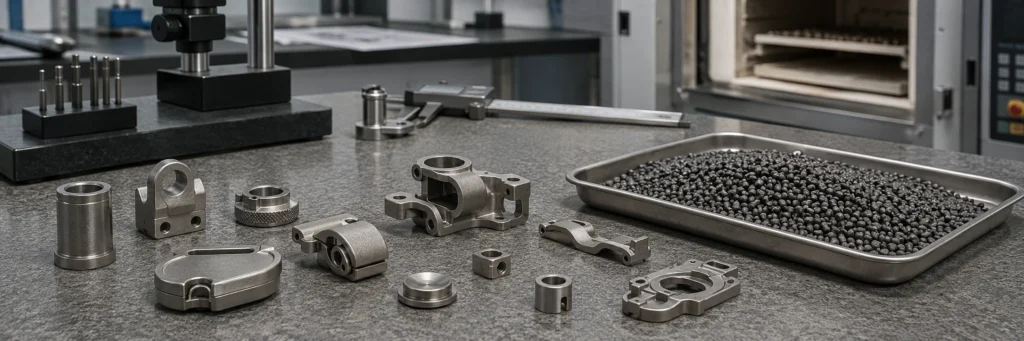
Share your drawing, material requirements, annual volume, tolerance needs, or application details. Our engineering team will review your MIM project and respond with technical feedback or a quotation.
Why MIM Material Datasheets Are Not Enough for RFQ Decisions
Blogs / MIM Material Selection Notes / Why MIM Material Datasheets Are Not Enough for RFQ Decisions ``` MIM Material Selection Notes Why MIM Material Datasheets Are Not Enough for RFQ Decisions MIM material datasheets are useful for early screening, but they are not enough for RFQ decisions. A datasheet can show typical chemical composition, …
Why MIM Material Datasheets Are Not Enough for RFQ Decisions
MIM material datasheets are useful for early screening, but they are not enough for RFQ decisions. A datasheet can show typical chemical composition, hardness, tensile strength, corrosion notes, magnetic behavior, or heat-treatment response. However, a metal injection molded part is not judged by material grade alone. Final part performance also depends on feedstock behavior, debinding and sintering control, density, geometry, wall thickness, shrinkage, tolerance targets, surface finishing, heat treatment, working environment, inspection requirements, and annual production volume.
Core decision: A datasheet answers material potential. RFQ review answers part feasibility.
Use datasheets for early material screening.
Use drawings and application requirements for RFQ decisions.
Review MIM process variables before tooling discussion.
Confirm finishing, inspection, and validation expectations early.
If the supplier only receives a material grade, the quotation can easily miss geometry risk, tolerance risk, finishing cost, inspection effort, and material availability questions.
Material datasheets help screen MIM options, but RFQ decisions require drawing, geometry, tolerance, and application context.
Core conclusion: Datasheet values are a starting point, not final proof of MIM part feasibility.
Quick answer: A MIM material datasheet is useful for early screening, but it cannot confirm RFQ feasibility by itself. For quotation, the supplier still needs the drawing, geometry, tolerance targets, working environment, finishing requirements, heat-treatment expectations, annual volume, and inspection needs. In a reliable MIM material comparison, datasheet values are reviewed together with part design, process route, and project risk.
```
Why Material Datasheets Are Useful—but Limited in MIM RFQs
Material datasheets are still valuable. They give engineers and sourcing teams a common starting point when comparing material candidates. In a MIM project, a datasheet may help identify whether a stainless steel, low-alloy steel, soft magnetic alloy, titanium alloy, copper alloy, nickel alloy, or special alloy family is worth reviewing further.
A datasheet can usually support early questions such as whether the material family and MIM material properties match the required corrosion, strength, hardness, wear, or magnetic behavior; whether the grade appears compatible with the target operating environment; and whether heat treatment, coating, passivation, or another secondary operation may be needed.
However, an RFQ decision needs more than these general indicators. A common mistake is to compare datasheet values as if they directly represent the final part. In MIM, the same alloy name can still lead to different project outcomes depending on the feedstock route, sintering response, part geometry, secondary operations, and inspection plan.
For this reason, datasheets should be treated as screening tools, not quotation tools. They help the engineering team ask better questions. They do not remove the need for drawing review, tolerance review, function review, or supplier engineering feedback. For a broader material-family view, use the MIM material comparison page as the higher-level decision guide.
```
What datasheets usually tell you
Chemical composition, representative mechanical properties, hardness, density, corrosion behavior, magnetic behavior, or heat-treatment direction.
What datasheets do not confirm
Final part performance, shrinkage behavior, tolerance feasibility, finishing route, inspection effort, tooling risk, or project-specific cost.
What Can Go Wrong When RFQs Rely Only on Datasheets?
Datasheet-only RFQs often create a false sense of certainty. The alloy name may look correct, but the supplier may still be missing the information needed to evaluate manufacturability, tolerance risk, finishing cost, or inspection scope.
```
Datasheet-Only Assumption
Possible RFQ Problem
Better Engineering Review Question
The material grade has enough strength.
The part may still fail to meet functional requirements if density, geometry, heat treatment, or load direction is not reviewed.
What final part condition, load direction, and inspection method must be confirmed?
The alloy is corrosion resistant.
The actual environment, surface condition, passivation, coating, or cleaning media may change the result.
What fluid, temperature, exposure duration, and surface requirement will the part face?
The grade is commonly used in MIM.
Feedstock availability, mold filling, and sintering stability may still depend on the part geometry.
Is the candidate material realistic for this wall thickness, feature size, and volume?
The datasheet shows a suitable hardness range.
Heat treatment, distortion, finishing, and inspection may add cost or dimensional risk.
What final hardness condition is required, and which dimensions are critical after treatment?
The material comparison is enough to quote.
Tooling risk, secondary operations, sample validation, and inspection effort may be underestimated.
What drawing, tolerance, finishing, volume, and validation information should be included?
A supplier can usually comment on a material candidate from a datasheet. A reliable quotation needs a broader review: material candidate, drawing, process route, finishing route, inspection plan, and production expectation.
```
Why MIM Processing Changes How Material Data Should Be Read
MIM is a process-driven manufacturing route. Fine metal powder and binder are processed into feedstock, molded into a green part, debound, sintered, and then inspected or finished according to the part requirements. Each of these steps can affect how the material behaves in the final component.
```
Feedstock, sintering, geometry, and finishing can change how a MIM material datasheet should be interpreted.
Core conclusion: Final MIM part performance depends on process route and part geometry, not material grade alone.
Feedstock route and powder-binder behavior
In MIM, material selection is connected to MIM feedstock preparation, feedstock availability, and processing behavior. A material may look attractive on a datasheet, but if a stable feedstock route is not available or not suitable for the geometry, the RFQ may require further review. Feedstock flow, solid loading, binder behavior, and mold filling stability can all influence part quality.
For RFQ decisions, this matters because the material grade cannot be separated from moldability. A material that looks strong or corrosion resistant on paper still needs to fill thin walls, small features, undercuts, or complex cavities without avoidable molding or shrinkage risk.
Debinding and sintering density
Datasheets often present material properties as standard values, typical values, or reference data. In MIM production, final part performance depends heavily on debinding and sintering control. Residual binder, carbon control, sintering atmosphere, sintering temperature, density, and residual porosity can affect mechanical behavior, corrosion resistance, dimensional stability, and repeatability.
This is especially important when the part has demanding strength, fatigue, hardness, magnetic, or corrosion requirements. The datasheet may provide a useful property range, but the RFQ should still ask how the supplier will control density, shrinkage, and inspection for the specific part.
Shrinkage, geometry, and dimensional control
MIM parts shrink during sintering. Tooling compensation, geometry balance, wall thickness transitions, hole position, flatness, and feature stability all affect whether a material choice is practical. A datasheet does not tell the supplier how a specific part will shrink, distort, or hold tolerance.
In production, this matters because RFQ cost and feasibility often depend on the part drawing rather than the material table. A simple part made from a demanding material may be easier to quote than a difficult geometry made from a common grade. Thin walls, uneven mass distribution, sharp transitions, deep slots, long spans, and tight positional tolerances can all change the risk profile.
Heat treatment and secondary operations
Some MIM materials are selected because they respond to heat treatment, surface finishing, passivation, coating, sizing, machining, or other secondary operations. A datasheet may show a material’s potential, but it does not confirm which post-sintering route is required for the final component.
For example, a grade may be selected for hardness, wear resistance, corrosion resistance, magnetic behavior, or strength. But the final result may depend on heat-treatment route, surface condition, dimensional change after treatment, masking requirements, coating thickness, or post-sintering machining needs.
MIM Variable
Why It Affects Material Decisions
RFQ Risk if Missing
Feedstock availability
Not every attractive material grade is equally practical for MIM feedstock and mold filling.
The supplier may need alternative material review before quotation.
Sintering density
Final strength, corrosion, magnetic, and dimensional behavior depend on sintering control.
Datasheet values may be misread as final part guarantees.
Geometry and wall thickness
Shrinkage, distortion, and tolerance depend on actual part design.
Tooling correction or secondary operation needs may be underestimated.
Heat treatment
Some grades require post-sintering treatment to reach target hardness or strength.
Cost, lead time, and dimensional change may be missed.
Surface finishing
Final corrosion, wear, friction, or appearance may depend on finishing route.
Coating, passivation, polishing, machining, or inspection cost may be missing.
If the material question is still broad, compare material families and property directions first. If the part already has a drawing, critical dimensions, finishing requirements, or application limits, move from datasheet review into drawing-based engineering review.
```
What a Datasheet Cannot Confirm Before Quotation
A material datasheet can support early comparison, but it usually cannot confirm the full RFQ decision. The supplier still needs project-specific information to evaluate manufacturability, cost, tooling risk, inspection effort, and process route.
```
Decision Area
What a Datasheet Can Tell You
What It Cannot Confirm for RFQ
What to Provide Instead
Material family
General alloy type and expected behavior.
Whether the material is suitable for the actual part geometry.
Candidate grade, target function, and application environment.
Mechanical properties
Typical strength, hardness, elongation, or heat-treatment response.
Whether the final MIM part will meet function after sintering and finishing.
Load direction, safety factor, and testing requirements.
Corrosion or wear behavior
General resistance notes or comparison direction.
Whether the final surface condition is enough for the working environment.
Fluid exposure, temperature, cleaning media, and surface finish.
Dimensional behavior
No direct part-specific shrinkage result.
Whether the part can hold critical tolerance after sintering.
2D drawing, 3D model, critical dimensions, and tolerance priorities.
Cost and lead time
Usually no reliable project cost.
Tooling, process route, finishing, inspection, and volume cost.
Annual volume, prototype stage, and finishing requirements.
Quality validation
May mention standard property ranges.
Required inspection, testing, and acceptance criteria.
Inspection plan, critical-to-function features, and validation needs.
A reliable MIM RFQ needs drawing, tolerance, environment, finishing, and volume information beyond the material datasheet.
Core conclusion: Datasheets describe material candidates; RFQ packages must describe the actual part and application.
Final part geometry and wall thickness
Geometry can change the RFQ more than the material name. MIM is well suited for small, complex metal parts, but each geometry still needs review. Thin walls, deep grooves, internal features, undercuts, small holes, fragile ribs, and uneven wall thickness can affect injection molding, debinding, sintering, and final inspection.
Tolerance targets and inspection requirements
A datasheet does not define the tolerance level required by the customer. It also does not tell which features are critical, which dimensions can be adjusted, and which surfaces require inspection. Marking critical dimensions and inspection expectations is essential before quotation.
Functional loads and working environment
Material datasheets often list mechanical or environmental properties, but RFQ decisions require application context. A part used in a dry indoor mechanism may need a different review from a part exposed to temperature cycling, corrosion media, wear contact, magnetic requirements, or repeated load.
Surface finish, coating, and post-sintering operations
Many MIM material decisions depend on final surface condition, not only base alloy properties. Surface finishing, passivation, polishing, coating, plating, heat treatment, or machining may be required to meet the application requirement.
For a more complete preparation path, the RFQ preparation guide can help project teams organize drawing, material, tolerance, finishing, and production information before supplier review. For a focused RFQ input article, see what to send for a MIM RFQ.
```
Datasheet Comparison vs. MIM Material Comparison
Datasheet comparison is property-based. MIM material comparison is project-based.
When engineers compare datasheets, they often compare tensile strength, hardness, density, corrosion behavior, magnetic response, heat-treatment notes, or typical elongation. This is useful for narrowing choices, but it is not the same as selecting the best material for a MIM part.
```
Datasheet comparison is property-based
Datasheet comparison helps the team understand material candidates at a high level. It can show whether the grade appears stronger, harder, more corrosion resistant, more magnetic, or more responsive to heat treatment.
MIM material comparison is project-based
A real MIM material comparison asks whether the material, feedstock route, part geometry, sintering behavior, finishing plan, tolerance target, inspection method, and production volume can work together.
Question
Datasheet-Level Answer
Project-Level MIM Review
Which material looks suitable?
Compare representative properties and material families.
Compare material candidates against drawing, environment, tolerance, finishing, and inspection needs.
Can the part be quoted?
Only roughly, if the supplier knows the material name but not the design risk.
More reliably, after reviewing geometry, critical dimensions, process route, and production volume.
Can the final part meet function?
Not confirmed by datasheet values alone.
Requires final part condition, test method, inspection plan, and application requirements.
The right question is not only “Which material has the better datasheet value?” The better question is “Which material, process route, geometry, finishing plan, and inspection plan can meet the project requirement with acceptable risk?”
If your team is still comparing stainless steel, low-alloy steel, soft magnetic materials, and special alloys at the family level, start with the MIM Material Comparison page. If the project needs broader grade-selection logic, the MIM material selection guide can help connect material families, part function, process risk, and RFQ requirements before supplier review.
```
A Practical Material-Decision Checklist for MIM RFQs
This checklist is not a complete RFQ package guide. Its purpose is to help engineers and sourcing teams identify the material-related information needed before a supplier can review whether a MIM material candidate is realistic for the actual part.
```
Material information to include
Provide the candidate material grade if known. If the material is not fixed, provide the target function instead. The project may require corrosion resistance, high strength, wear resistance, magnetic response, heat resistance, controlled expansion, or conductivity.
Drawing and tolerance information to include
Provide a 2D drawing and 3D model where possible. Mark the critical dimensions, tolerance targets, functional surfaces, mating features, holes, threads, datum surfaces, and any areas where distortion would affect assembly.
Application and validation information to include
Explain the working environment. Include temperature, corrosion exposure, wear contact, load direction, operating cycle, cleaning media, magnetic requirement, electrical requirement, surface appearance requirement, or any reliability concern.
Production and commercial information to include
Provide estimated annual volume, target production stage, expected sample quantity, and any known inspection or validation requirements. Even a rough volume range helps the supplier review tooling and production economics.
Material Decision Inputs Before Supplier Review
Candidate material or required function
2D drawing and 3D model
Critical dimensions and tolerance targets
Functional surfaces and assembly interfaces
Working environment and exposure conditions
Surface finish, coating, or heat-treatment requirements
Annual volume and project stage
Inspection or validation expectations
Alternative materials allowed or not allowed
If the project team has not selected a final material, that is acceptable. A clear function requirement is often more useful than forcing a material grade too early. For the full RFQ package structure, use the RFQ preparation guide or the article on what to send for a MIM RFQ.
```
When to Escalate Material Comparison to Supplier Engineering Review
Material comparison should become supplier engineering review when the decision affects tooling, tolerance, performance, or production risk.
```
Supplier review connects material data with manufacturability, tolerance risk, finishing route, and RFQ readiness.
Core conclusion: When datasheet comparison is not enough, the next step is drawing-based material review.
When performance requirements are close to the limit
If the part must meet demanding strength, hardness, corrosion, wear, magnetic, fatigue, or temperature requirements, the project should not rely only on datasheet values. The supplier should review the part function, material route, heat treatment, surface condition, and inspection plan before quotation.
When geometry or tolerance is difficult for MIM
If the part has thin walls, deep slots, long unsupported features, tight holes, flatness requirements, or critical assembly surfaces, the material decision should be reviewed with geometry. A common material can still be risky if the geometry is difficult.
When heat treatment or finishing may change the result
If the part needs heat treatment, passivation, polishing, PVD, plating, machining, sizing, or other post-sintering operations, the supplier should review whether those operations are compatible with material, geometry, tolerance, and cost expectations.
When multiple material candidates remain after screening
If two or more material candidates still look possible after datasheet comparison, the next step is not always another datasheet. It may be a drawing-based review that compares manufacturability, tooling risk, finishing route, cost drivers, and inspection needs.
Shortlisting material families or eliminating clearly unsuitable options.
The drawing already includes critical tolerances, functional loads, or production volume targets.
Known material grade
Checking whether the material appears compatible with the design intent.
The final part needs heat treatment, finishing, coating, or special inspection.
Two candidate materials remain
Comparing general property direction.
The choice affects tooling risk, sintering distortion, secondary operations, or total landed cost.
```
Composite Field Scenario for Engineering Training
A project team is comparing 316L stainless steel and 17-4 PH stainless steel for a small metal component. The datasheets show different strength, hardness, and corrosion behavior. At first, the team wants to choose the material based on mechanical values alone.
During review, the decision becomes more complex. The part has thin walls, a small hole pattern, a functional surface, and a corrosion exposure requirement. The team also needs to decide whether heat treatment is acceptable, whether post-sintering machining is needed, and how critical dimensions will be inspected.
In this scenario, the datasheet helps identify the material candidates, but it does not decide the RFQ. The supplier still needs the drawing, function, tolerance targets, application environment, annual volume, and validation expectations before recommending a material route.
Engineering lesson: datasheets help engineers compare materials, but RFQ decisions require project context.
FAQ: MIM Material Datasheets and RFQ Decisions
```
Can I choose a MIM material only from a datasheet?
A datasheet can help you shortlist material candidates, but it should not be the only basis for a MIM RFQ decision. Final part performance depends on geometry, sintering density, tolerance targets, surface finishing, heat treatment, application environment, and inspection requirements.
Why do MIM material properties differ from wrought or machined material datasheets?
MIM uses fine metal powder, binder, injection molding, debinding, and sintering. Because the manufacturing route is different from wrought bar, casting, forging, or machining from stock, final part behavior may depend on density, residual porosity, sintering control, and secondary operations.
What should I send with a material datasheet for a MIM RFQ?
Send the 2D drawing, 3D model if available, candidate material or target property, critical dimensions, tolerance requirements, surface finish expectations, operating environment, annual volume, and any inspection or validation requirement. This helps the supplier evaluate the project beyond material grade alone.
Does higher tensile strength always mean a better MIM material choice?
No. A higher tensile value may be useful, but it does not automatically mean the material is better for the part. Corrosion, wear, hardness, magnetic behavior, heat-treatment response, geometry, tolerance, cost, and finishing requirements may be more important for the actual application.
When should a MIM material comparison become a supplier engineering review?
Material comparison should become supplier review when the part has demanding performance requirements, difficult geometry, tight tolerance, uncertain heat treatment, special surface finishing, multiple material candidates, or unclear production volume. At that stage, the supplier should evaluate the drawing and application context together.
```
Engineering Review Note
This article is prepared by the XTMIM Engineering Team for product engineers, sourcing teams, and project managers reviewing MIM material options before RFQ. The purpose is to explain why datasheet-based material comparison should be combined with drawing review, tolerance review, application conditions, finishing requirements, and production expectations before tooling or quotation.
```
Technical Note
Material datasheets and public material standards are useful references for early material screening. They should be used together with drawing review, application requirements, manufacturing route, heat-treatment condition, surface finishing requirements, and inspection planning before a MIM material is approved for RFQ or tooling discussion.
```
Technical References for MIM Material Review
The following external references may help engineering and sourcing teams understand MIM material standards, material property interpretation, and process-related background before RFQ review.
MPIF Standards Resources
— Background reference for powder metallurgy and MIM material standards resources.
Compare MIM materials with your actual part requirements
If you are comparing MIM materials for a new part, do not rely on datasheet values alone. Prepare the drawing, candidate material, functional requirement, tolerance targets, surface condition, application environment, and annual volume. XTMIM can review whether the material choice, geometry, process route, and RFQ information are aligned before tooling discussion.