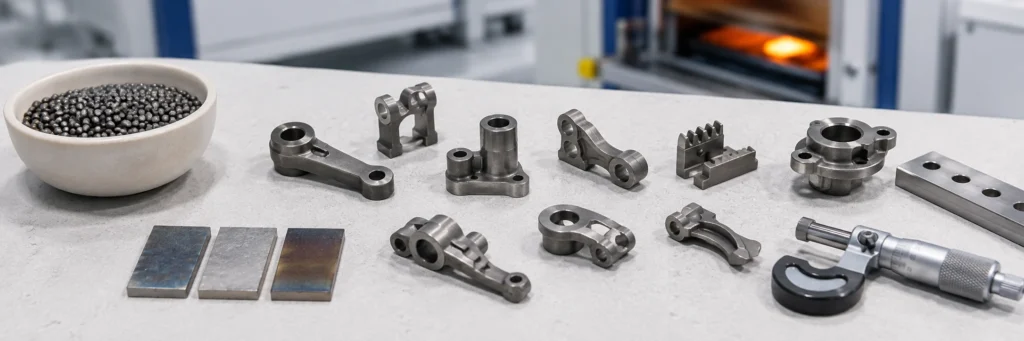
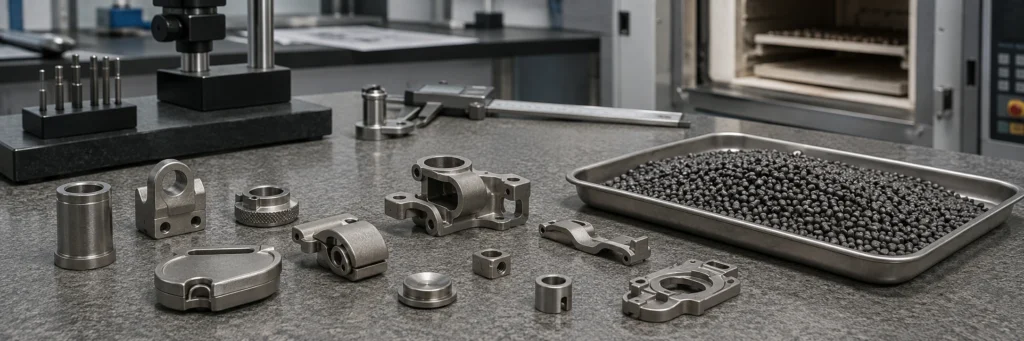
Share your drawing, material requirements, annual volume, tolerance needs, or application details. Our engineering team will review your MIM project and respond with technical feedback or a quotation.
2026 MIM Industry OutlookMIM industry trends in 2026 reflect a combination of market opportunity and manufacturing reality. Metal injection molding continues to serve established high-volume markets for small, complex components, while verified applications in surgical devices and electronic thermal management demonstrate broader functional potential. Market researchers expect further growth, although the strength of demand differs …
MIM industry trends in 2026 reflect a combination of market opportunity and manufacturing reality. Metal injection molding continues to serve established high-volume markets for small, complex components, while verified applications in surgical devices and electronic thermal management demonstrate broader functional potential. Market researchers expect further growth, although the strength of demand differs by region and application. At the same time, tooling economics, material qualification, sintering repeatability, and supply-chain conditions still determine which opportunities can become reliable production programs.
A production case proves that a specific part can be manufactured; a market forecast only estimates potential demand. New alloys and integrated functions still need qualification before they become dependable commercial programs.
How Is the MIM Market Changing in 2026?
Market forecasts suggest growth, but are not production results
Market research indicates continued demand for metal injection molding, but estimates vary. Grand View Research estimates the global MIM market at USD 6.5 billion in 2025 and USD 7.2 billion in 2026. Mordor Intelligence uses a different estimation model and puts the 2026 market at USD 5.85 billion. These figures should be read as research estimates, not audited industry revenue; their methodologies and market boundaries need not match.
The Metal Powder Industries Federation's 2026 North American industry report offers a more cautious picture of current conditions. It describes resilience in MIM, with particular strength in medical and stainless steel applications, but also notes tariffs, inflation, labor shortages, and overseas competition. The report characterizes expectations for a recovery as cautiously optimistic rather than guaranteed.
Regional markets are not moving in exactly the same way
Asia remains a major center of MIM production. Grand View Research attributes 53% of global MIM revenue in 2025 to Asia Pacific. A June 2026 PIM International industry analysis explains that Greater China's manufacturing ecosystem combines powder and feedstock suppliers, tooling, sintering capacity, and consumer-electronics supply chains.
This industrial concentration matters because success in MIM depends on more than molding machines: feedstock availability, mold expertise, furnace control, secondary processing, and downstream demand must work together. North America's cautious recovery expectations and Asia's established production infrastructure describe different regional conditions, not a uniform rate of global growth.
Which Applications Are Shaping MIM Demand in 2026?
Established demand in electronics and automotive hardware
Consumer electronics and information-and-communications-technology (ICT) products remain important demand foundations, particularly within Asia's established MIM supply chain. Miniaturized structures, compact mechanisms, and components that would otherwise require several machining or assembly operations can make MIM attractive when manufacturing volumes justify tooling. The PIM International analysis of Asian MIM describes these sectors as major drivers of regional production.
Automotive components have a long history of serial MIM production. In March 2026, Bosch reported that its Immenstadt facility had produced a cumulative one billion MIM parts since series production began in 2006. That figure is a long-term production milestone, not a 2026 annual growth rate. It illustrates the industrial maturity possible when complex geometries are backed by controlled manufacturing and inspection.
Medical mechanisms and functional thermal components
MIM also serves components that must deliver precise mechanical motion or thermal functions, not only compact metal shapes. The MPIF 2026 Design Excellence Awards include MIM components used in an articulated surgical vessel-sealing device. The assembly contains several functional parts, including jaws, hubs, a pulley, and an actuator hub. These components demonstrate MIM use in complex instrument mechanisms. One award, however, cannot establish the growth rate of the entire medical MIM market.
The same awards recognized a pure-copper MIM heat-dissipation component for high-power optical modules. Its integrated air ducts manage airflow and directional heat dissipation while also providing structural support. Selected surfaces receive local CNC machining, combining MIM's complex geometry with targeted secondary precision.
Established serial applications sustain production volume, while specialized functional parts broaden where MIM may offer an advantage. The MIM industries overview provides further examples of industries and components already using the process.
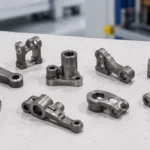
Figure 1. Examples of medical, automotive, and thermal-management applications. The graphic groups applications; it does not show measured market growth rates.
How Are MIM Materials and Manufacturing Capabilities Evolving?
Material options are broader, but maturity differs by alloy and application
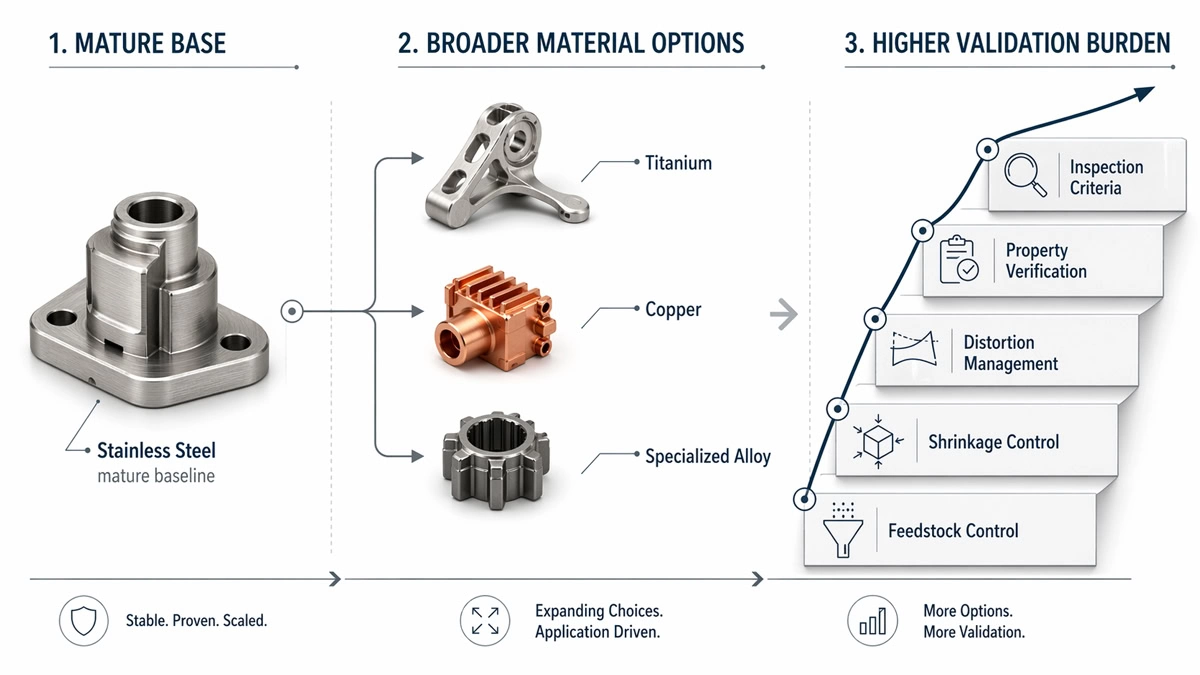
Stainless steels and selected low-alloy steels remain important parts of MIM's established manufacturing base. Additional materials can serve different functional needs, but the distinction between a published material specification, a successful sample, and repeatable commercial production is essential.
For example, the 2025 edition of MPIF Standard 35-MIM added material data for commercially pure titanium and Ti-6Al-4V, along with certain stainless steel updates. Published in 2025, the standard remains a relevant material reference in 2026. The pure-copper optical-module case demonstrates a specific production application, but it does not establish copper-MIM readiness at every supplier.
A material may be theoretically suitable for MIM without an established feedstock route, stable debinding and sintering response, or qualified post-processing and inspection plan at a particular factory. Broader material choice is therefore an opportunity whose commercial value depends on validated manufacturing conditions. For additional alloy properties and application options, see the MIM materials overview.
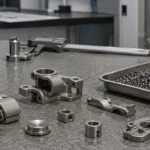
Figure 2. Illustration of material maturity and application-specific qualification. Individual material readiness differs by manufacturer and production route.
Complex applications place greater value on integrated process control
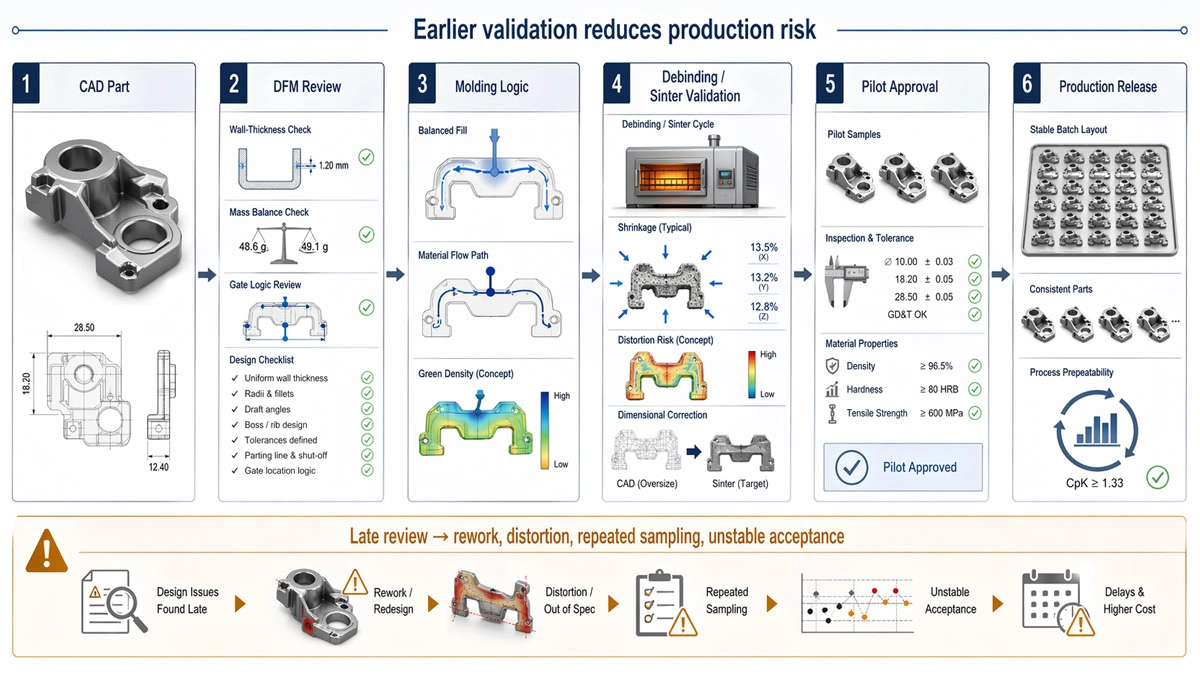
Gate placement, wall-thickness transitions, local mass concentration, unsupported features, and allowance for sintering shrinkage remain fundamental to MIM manufacturability. Their effects become harder to manage when the same part also has strict cosmetic, corrosion, dimensional, and batch-consistency requirements.
A drawing can look suitable for injection molding yet create distortion, inconsistent shrinkage, or expensive correction after sintering. Reviewing geometry early through design for manufacturability (DFM) helps identify those risks before tooling and sampling decisions become costly. The MIM design guide covers those part-level decisions in detail.
The manufacturing route must then behave predictably from feedstock and molding through debinding, sintering, finishing, and inspection. Bosch's description of its MIM operation illustrates how equipment, material control, hardening, finishing, and automated inspection can be integrated for sustained serial production. The equipment and control methods needed for similar consistency depend on the factory, alloy, and component.
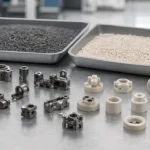
Figure 3. Early geometry review, pilot trials, and process qualification help identify shrinkage and distortion risks before serial-production release.
MIM and metal additive manufacturing increasingly overlap
MIM's established strength is economical repeated production of geometrically complex components once the tooling and process are qualified. Metal additive manufacturing can offer advantages when geometry changes frequently, tooling must be avoided, or quantities are limited. The two processes also share parts of the metal-powder supply chain, and some manufacturers use additive methods to support prototyping before deciding on production tooling.
The 2026 PIM International review documents increasing overlap in Asian manufacturing and selected ICT applications. This development does not make the processes interchangeable. Actual geometry, alloy, required properties, inspection criteria, lead times, and production volumes still determine the appropriate route.
What Still Limits Wider MIM Adoption?
Tooling and production volume remain economic boundaries
MIM is not automatically the best process for every small metal part. A geometry that can be molded may still be a poor fit when annual volumes are low, design changes are frequent, or a critical feature requires extensive secondary machining. Tooling cost must be considered together with projected production quantities, part complexity, post-sinter operations, and expected yield.
Even when a geometry can be molded, MIM is commercially suitable only if the full process can deliver consistent parts at a competitive total cost over the intended production life. For some projects, CNC machining, conventional powder metallurgy, investment casting, or metal 3D printing may be more practical.
Material qualification and repeatability affect total project cost
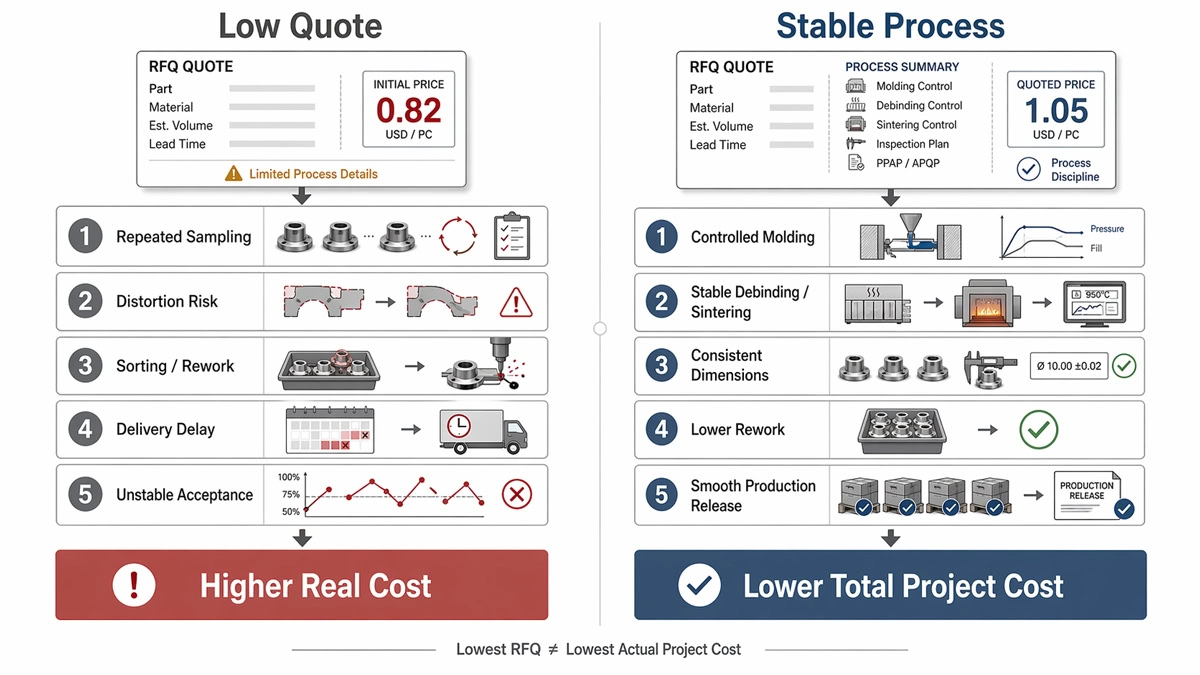
A low initial quotation can lose its advantage through repeated trial runs, unstable post-sinter dimensions, excessive sorting, or unplanned finishing. Variation can arise from powder and feedstock behavior, molding consistency, debinding response, furnace conditions, part support, or dimensional inspection strategy. A material claim is therefore incomplete without clarity on grade, acceptance criteria, production history, and the capabilities of the particular process route.
Early qualification should define the important requirements: dimensions and tolerances, density where relevant, mechanical or corrosion performance, surface condition, and batch-to-batch consistency. The exact set depends on the component; not every property applies to every part. As parts take on more demanding functions, those established controls have a greater impact on production yield, repeatability, and cost. The MIM process guide explains the underlying steps.
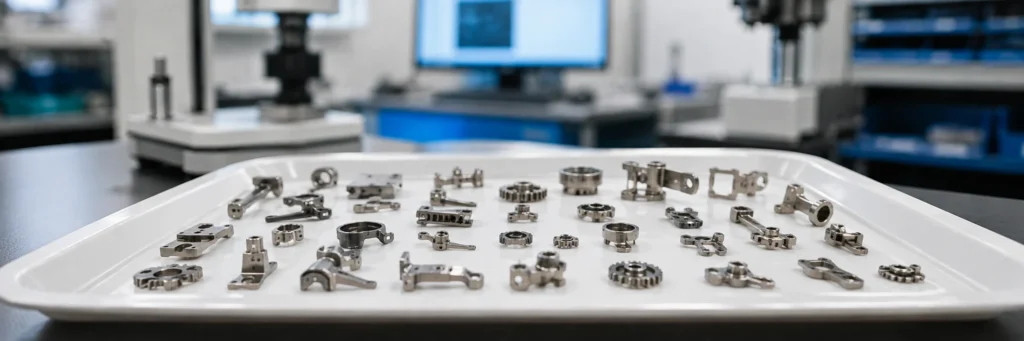
Figure 4. A low initial quote can be offset by repeated sampling, distortion, sorting and finishing costs. This is a conceptual comparison, not measured industry cost data.
Supply-chain conditions and competing processes still matter
The MPIF's 2026 industry report highlights tariff volatility, cost pressure, labor constraints, and global competition. For MIM projects, these external pressures interact with alloy availability, tooling and furnace capacity, and the time needed to qualify an alternative supplier or material route. Sustainable growth therefore depends on qualified material supply, available production capacity, and part designs that remain economically viable under those conditions.
What Can We Expect from the MIM Industry Beyond 2026?
Established applications may continue moving toward more integrated functions
Near-term MIM growth is more likely to extend applications already proven in production: high-volume precision components, compact moving mechanisms, and parts that combine structural and functional requirements. Continued development in electronics, medical instruments, and industrial applications is plausible where the part geometry, performance, and production quantity align with MIM's strengths.
The surgical-instrument mechanism and copper optical-module component demonstrate specific, documented applications. Transferring similar designs into new production programs still requires material qualification, dimensional validation, and acceptable yields; neither case guarantees growth across an entire market.
New opportunities may develop in robotics, advanced communications hardware, thermal-management assemblies, and materials that offer properties beyond familiar stainless steels. The 2026 Asian MIM industry analysis identifies expanding supply-chain overlap and emerging uses, but the maturity of individual programs will differ.
To judge whether an emerging direction is becoming an established market, look for repeat production, documented material and dimensional performance, sustainable yields, and a reason to choose MIM over competing methods. A published prototype, one award, or an optimistic market forecast is not enough to establish widespread commercial adoption.
What Do These Trends Mean for OEMs and Manufacturers?
A growing application market does not automatically make a new component suitable for MIM. Market forecasts describe potential demand, while documented production cases show what particular manufacturers and process routes have achieved.
An OEM considering MIM should first test whether the part's geometry, material, tolerances, and expected production quantity fit the process. The next question is whether molding, debinding, sintering, secondary operations, and inspection can deliver the required outcome consistently. Finally, evaluate total project economics rather than an isolated tooling or unit-price figure. These long-established engineering checks remain decisive when new alloys or more demanding functions are introduced.
The 2026 outlook is one of selective expansion rather than unlimited substitution. MIM has a mature volume-production foundation and credible examples of more demanding functional applications. Its future opportunities will be strongest where product design, qualified materials, stable manufacturing, and commercial volume align. If a specific component is under evaluation, an engineering review based on drawings and intended volume is more useful than treating a market forecast as a manufacturing guarantee. XTMIM provides a drawing review submission path for that next step.