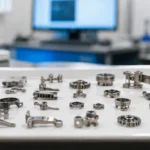
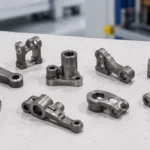
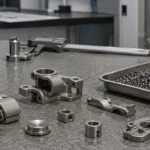
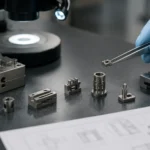
Quick Answer: Industry requirements affect MIM material selection by changing which properties the finished part must deliver. A corrosion-resistant 316L medication-cart handle, a high-strength 4605 engine oil-spray component, a hardened 420 surgical drill-guide frame, and a soft-magnetic Fe50Ni sensor component serve different functions. The MIM material selection matrix compares real applications, alloys, and performance requirements; …
Quick Answer: Industry requirements affect MIM material selection by changing which properties the finished part must deliver. A corrosion-resistant 316L medication-cart handle, a high-strength 4605 engine oil-spray component, a hardened 420 surgical drill-guide frame, and a soft-magnetic Fe50Ni sensor component serve different functions. The MIM material selection matrix compares real applications, alloys, and performance requirements; a grade used successfully in one component is not automatically right for another.
There is no single “medical MIM steel,” “automotive MIM alloy,” or “electronics MIM material.” A corrosion-exposed handle, a load-bearing linkage, and a wear-sensitive mechanism can call for different grades, even within the same industry. Conversely, 17-4PH stainless steel is used in medical instruments, vehicle locking mechanisms, industrial tools, and security hardware where higher mechanical performance is required.
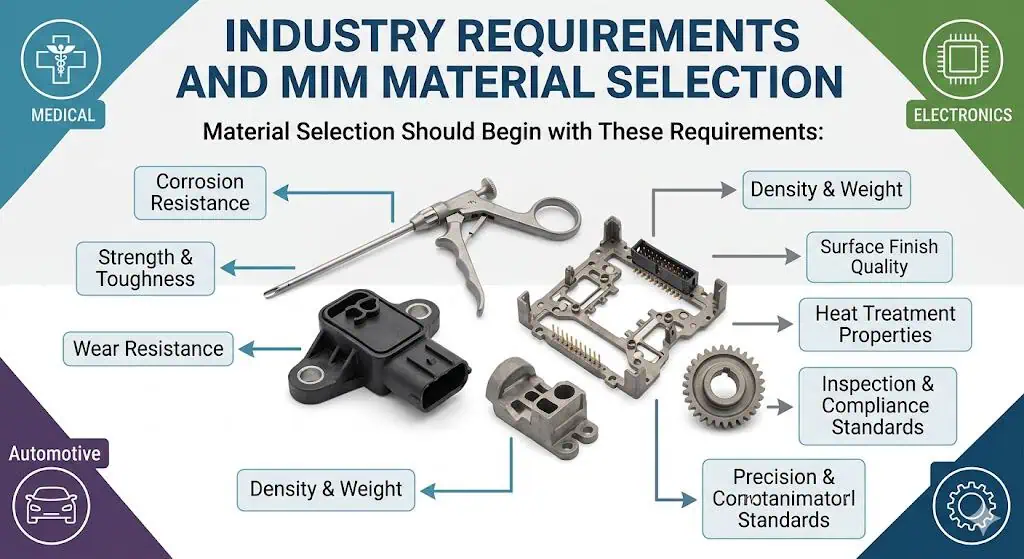
Industry Requirement vs MIM Material Selection Matrix
The material selection matrix connects actual MIM components to their alloys and the requirements they address. Medical-equipment hardware, parking-lock gears, precision electronic parts, and magnetic sensors do not share the same material priorities. Each entry describes a specific application, not a blanket material specification for an industry.
| Industry / typical component | Documented MIM material | Requirement that matters | Practical risk or check |
|---|---|---|---|
| Medical equipment: medication-cart locking handles | 316L stainless steel | Corrosion resistance, strength, and low magnetic response in the published use | Do not equate medical-equipment hardware with a wear-critical tool or an implantable device. |
| Medical / dental: endoscopic parts, drill-guide frame, orthodontic expander | 17-4PH + 420 (endoscopic assembly); 420 (drill-guide frame); 17-4PH (orthodontic expander) | Articulation and precision fit; heat-treated frame hardness; durable threaded dental components | Confirm alloy-to-part mapping and final treatment; the endoscopic source does not identify each part's individual grade. |
| Automotive: oil-spray cooler, parking-lock worm gear, SCR nozzle | 4605 (oil-spray cooler); 17-4PH (parking-lock gear); HK30 (SCR nozzle) | Strength and oil-flow function; torque transfer; exposure to SCR process media | Check the actual mechanical condition, oil-channel clearance, gear engagement, and nozzle service conditions. |
| Consumer electronics: earphone nozzle assembly | 316L stainless steel | Visible surface, fine threads, fit, and material performance | Check cosmetic surfaces and finishing response; avoid assuming this case proves a specific sweat-corrosion rating. |
| Industrial tools and locks: cable-tie tool and digital door lock | 17-4PH stainless steel | Force transfer, hardness, and repeatable mechanical operation | Review contact conditions and the specified heat-treatment state; hardness alone does not predict wear life. |
| Industrial equipment: printer guide catches and support tabs | 316L guide catches; 440C support tabs | Paper guidance versus impact-loaded printer-head support | Use the published properties for these parts only, not as universal alloy guarantees. |
| Industrial sensors: gas-flow sensor casing and ground | Fe50Ni soft-magnetic alloy | High permeability and low coercive field | Verify magnetic behavior in the finished MIM condition, not only the nominal alloy designation. |
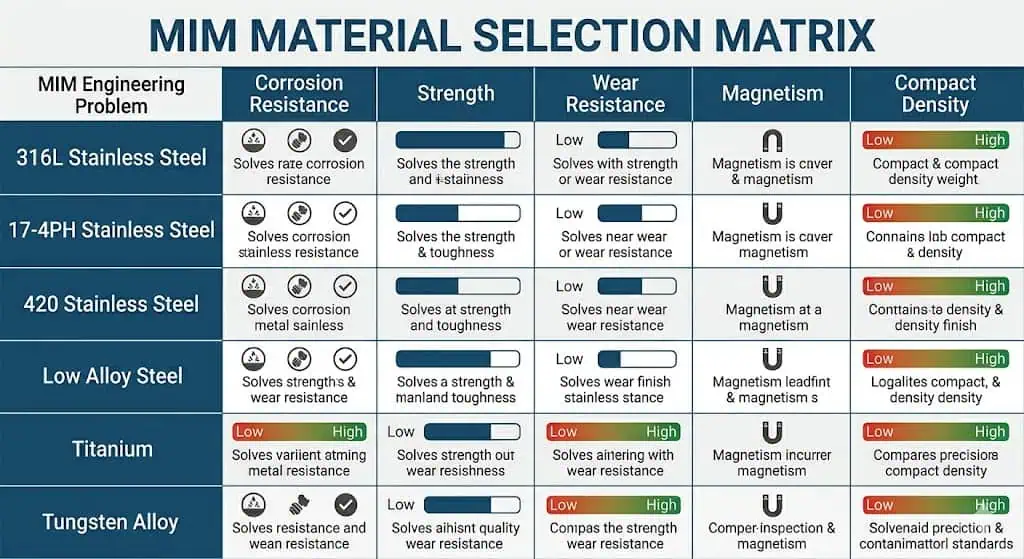
Start with the part’s function, then compare the properties it requires: corrosion resistance, strength, hardenability, wear behavior, surface finish, or magnetic response. The MIM material comparison covers differences between grades; the MIM material selection guide addresses broader engineering trade-offs.
Medical and Dental MIM Materials: Different Functions, Different Alloys
Medical and dental devices do not have a single material requirement. Equipment hardware may prioritize resistance to cleaning environments, secure handling, and surface integrity. Articulating instruments, drill-guide fixtures, and orthodontic mechanisms can instead require stronger or harder components with accurate mating features. A medical application also does not automatically imply that a component is implantable or approved for patient contact.
Corrosion-resistant equipment hardware: why 316L is considered
316L is an austenitic stainless steel suited to applications that value corrosion resistance, cleanable surfaces, and ductility over high hardness. MPP Innovation converted medication-cart locking handles from plastic to MIM-316L. For that component, the manufacturer identified greater strength, corrosion resistance, and low magnetic response as important requirements.
The original plastic handles could be defeated by simple tampering, so the change to MIM-316L addressed a specific strength and security problem alongside the stated corrosion-resistance and low-magnetic-response requirements. The manufacturer also reports that one handle needed sintering support and section-thickness reduction, while both designs needed coining to restore interrupted internal diameters after sintering. Those measures addressed shape and fit; they were not inherent properties of 316L. The project called for low magnetic response, but processed 316L should not be assumed completely non-magnetic without measurement. Exposure to specific cleaning agents and the required corrosion or surface condition must also be verified for the actual equipment.
Articulating and hardenable components: where 17-4PH and 420 appear
17-4PH gains much of its strength through precipitation hardening during aging, whereas 420 is a martensitic stainless steel whose hardness depends on the hardening and tempering route. These are different ways of meeting mechanical requirements, not interchangeable labels for a strong stainless steel. A moving joint may call for load capacity and reliable fit, while a positioning fixture may specify a minimum finished hardness. Corrosion exposure, contact condition, and final heat-treated dimensions must still be considered. The MIM material properties reference compares material families; the British Stainless Steel Association explains 17-4PH age hardening, but finished MIM-part properties remain process-dependent.
Endoscopic articulation components. A MIMA thoracic-surgery device uses four MIM parts: an articulation lock bar, connector, drive block, and knife guide. The assembly contains MIM 17-4 and MIM 420. The source does not assign an individual alloy to each component, so its exact material choice must still be matched to the part’s mechanical and contact requirements.
A surgical targeting drill-guide frame uses MIM-420 to hold and align a targeting guide in a tarsometatarsal fusion procedure. In that project, hot isostatic pressing was used to achieve an average density of 7.7 g/cm³; subsequent sizing controlled the frame geometry, and vacuum heat treatment followed by tempering met the specified minimum 40 HRC hardness. The distinction matters: 420 supplies a hardenable material system, while the finished frame also depends on density, dimensional correction, and its final treatment condition. Neither 7.7 g/cm³ nor 40 HRC is an automatic specification for every MIM-420 component.
Dental mechanisms can have similar mechanical demands. The A-to-Z orthodontic expander contains seven MIM-17-4PH components with threaded and fitted features. Strength, durability, and accurate fit matter in that moving assembly, whereas corrosion-oriented medical-equipment hardware may place greater emphasis on 316L’s surface and environmental performance.
Specialized medical applications may also consider titanium, cobalt-chromium, or tungsten-based systems, but these are not interchangeable with standard stainless MIM grades. Their actual application specification, feedstock route, and qualification requirements must be separately established.
Automotive MIM Materials: Operating Requirements and Alloy Selection
Automotive MIM alloys vary with component function. An engine oil-spray element carries oil through intersecting passages; a parking-lock worm gear transmits torque; an SCR nozzle operates with urea and compressed air in an exhaust-treatment system. These parts encounter different loads and media, so their materials cannot be selected from a single automotive-grade list.
Engine oil-spray components: a documented 4605 low-alloy steel application
A heavy-vehicle piston-cooling oil-spray component uses MIM-4605 low-alloy steel and contains intersecting oil passages. The manufacturer relates the material choice to the required properties and operating environment. The reported finished component achieved a density of 7.55 g/cm³ and a tensile strength of 1,550 MPa.
The same part also illustrates a separate requirement that material strength alone cannot satisfy. Oil passes through holes intersecting the main bore at different angles; the original machining route was difficult, and a burr blocking one intersection would compromise the flow path. MIM tooling and molding control provided the complex channels, while the selected 4605 alloy supplied the documented mechanical-material route. For a comparable part, channel clearance and unobstructed oil flow would need to be checked separately from tensile properties and density; the published case does not report a universal flow-test limit.
4605 is a strength-oriented low-alloy steel rather than a corrosion-first stainless grade. Its heat-treatment response may be valuable where strength is a priority; environmental corrosion protection must be assessed separately. The 1,550 MPa result describes the cited component and manufacturing condition, not a guaranteed property of every MIM-4605 part.
Transmission locking and SCR systems: different reasons for different alloys
A commercial-vehicle parking-lock worm gear is made from MIM-17-4PH. Its helical teeth and shaft transmit torque in the locking mechanism, creating a different set of material demands from an engine oil-spray component. The published application identifies the material and function but does not establish whether corrosion resistance or a particular fatigue-life target was the decisive selection criterion.
Here, the operating load passes through the helical tooth contact into the mating assembly. Tooth form, engagement, and torque transfer therefore matter to part function alongside material strength. The MIMA case reports that the gear was functional without secondary processing, but gives no individual tooth-contact stress limit, fatigue life, or specific aging condition. Those values must be established for a new locking mechanism rather than inferred from the alloy name or this successful example.
An SCR nozzle in a commercial vehicle uses AISI HK30 austenitic stainless steel. The nozzle functions in a selective catalytic reduction system that uses urea and compressed air. This application brings fluid and exhaust-treatment conditions into the material decision, in contrast with the mechanical demands of a parking-lock gear.
The HK30 case also required a removable insert to form internal undercut passages, followed by thread machining, sealing welds, and grinding of the nozzle tip. These operations addressed channel shape, sealing, assembly and final geometry rather than proving a particular corrosion life for HK30. The documented grade is an austenitic stainless steel used in this SCR environment; selecting it for another nozzle would still require checking the actual process media, temperature exposure and applicable performance requirements. The case does not disclose a comparative alloy-selection test.
These three automotive components show why the material and the functional feature must be evaluated together: 4605 is specified for an oil-spray part that must also retain clear passages; 17-4PH is used in a torque-transmitting park-lock gear; and HK30 is used in an SCR nozzle with demanding internal-channel and assembly features. For production, material condition and repeatability matter, but the relevant functional check differs—flow clearance, gear engagement, or nozzle integrity. A single generic automotive material checklist would miss those distinctions.
Consumer Electronics MIM Materials: Appearance and Functional Performance
Visible consumer-electronics parts must often deliver precise mechanical fit and a clean, consistent exterior. A grade with sufficient strength may still be unsuitable if its finished surface cannot meet the product’s cosmetic standard. Fine threads, locking lugs, and closely fitted miniature assemblies make both requirements important.
Professional earphone nozzle assembly. MIMA describes three MIM-316L parts in a sound-isolating earphone: the nozzle interface, outer nozzle, and metal collar. They connect through locking lugs or fine metric threads. The product requires consistent visible surfaces, accurate assembly features, and specified mechanical properties.
For the earphone components, 316L provides a corrosion-resistant stainless substrate with the mechanical performance documented for the assembled product, while MIM provides the intricate locking lugs and fine threads. These are different selection decisions: the alloy must satisfy product material and appearance requirements; the manufacturing route must deliver the shapes and fit. Where a wearable component is exposed to perspiration, that environment requires its own corrosion assessment—the cited earphone case does not establish a sweat-corrosion rating or a PVD qualification result.
Surface finishing can determine whether a selected MIM alloy produces an acceptable visible part. Polishing may expose near-surface pores, PVD may accentuate small pits or color variation, electroplating requires a clean substrate for adhesion, and blasting can round fine edges. These are manufacturing risks to evaluate for the proposed finish, rather than defects identified in the earphone components.
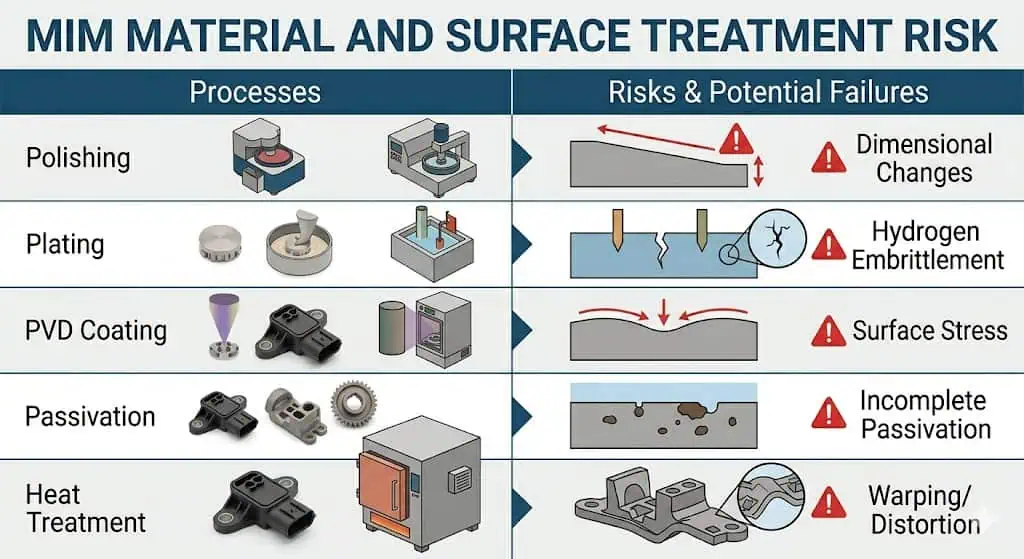
A wearable hinge carrying repeated loads may justify evaluating 17-4PH for higher strength instead of choosing 316L primarily for appearance and corrosion behavior. The choice still depends on heat-treatment dimensional change, wear contact, corrosion exposure, surface finish, and assembly fit.
Industrial Tools and Locking Mechanisms: Strength, Hardness, and Wear
Industrial tools and locking mechanisms use compact components to transfer force, engage mating features, and operate repeatedly. Precipitation-hardening stainless grades can meet strength and hardness requirements in both fields. Wear life, however, also depends on contact pressure, mating material, surface condition, and lubrication—not hardness alone.
17-4PH components in an industrial cable-tie tool
A cable-tie installation tool contains six MIM-17-4PH parts: a pinion, pawl gripper, insertable rack, cutoff cam, nosepiece, and short link. Their combined action tensions and cuts the cable tie. The design includes accurate gear teeth and controlled holes, with limited post-sinter finishing on selected features.
The pinion teeth, pawl, and cutoff cam have different local contact duties, even though they use the same alloy family. The case does not supply wear-life curves for each feature. For a new mechanism, contact stress, mating materials, surface roughness, and lubrication must therefore be evaluated alongside alloy strength and hardness.
Age-hardened 17-4PH in digital-door-lock assemblies
A digital-door-lock mechanism uses six MIM components, including the knob shaft, clutch, and control sleeve actuator. The parts are made from 17-4PH stainless steel aged to H900, selected for its combination of strength, hardness, and corrosion resistance.
The H900 condition is a defined aging treatment state, not a synonym for every 17-4PH part. Age hardening changes strength and hardness, while the actual friction pair also depends on contact geometry, mating surfaces and lubrication. Consequently, the cited door-lock case supports its particular combination of strength, hardness and corrosion requirements, but does not provide a universal cycle-life or wear-rate limit. For another mechanism, 420 or heat-treated low-alloy steel may deserve evaluation when the required hardness or corrosion conditions differ; the final decision would still depend on processing and functional tests.
Industrial Equipment and Sensors: Structural vs Functional Materials
Some MIM components need corrosion-resistant guidance surfaces, others need hardened supports, and some are chosen chiefly for their magnetic properties. An industrial printer and a gas-flow sensor illustrate how widely the required material behavior can differ.
316L guide catches and 440C support tabs in one printer assembly
An industrial printer uses MIM-316L guide catches to feed and guide paper, and MIM-440C support tabs to position the print-head module under impact loading. The two components operate in the same device but require different mechanical properties.
| Property | MIM-316L guide catches | MIM-440C support tabs |
|---|---|---|
| Ultimate tensile strength | 520 MPa | 1,670 MPa |
| Yield strength | 175 MPa | 1,615 MPa |
| Reported hardness | 67 HRB | Above 50 HRC |
Source: MIMA — Printer Datums and Tabs. Values are specific to the reported finished parts; HRB and HRC are different Rockwell scales.
In the reported condition, the 440C support tabs have substantially higher strength and hardness than the 316L guide catches. That difference corresponds to their jobs; the harder grade is not necessarily the better choice for a corrosion-oriented guide or a cosmetic housing.
Fe50Ni when magnetic properties are the primary requirement
The casing and ground components of an industrial gas-flow sensor are made from MIM-Fe50Ni soft-magnetic alloy. The application requires high magnetic permeability and a low coercive field—properties that cannot be established by ordinary tensile-strength testing.
The actual sensor parts also have thin walls and changing cross-sections. MIMA reports that both were formed in four-cavity tools and positioned strategically during sintering to limit distortion. This is significant because an alloy can be magnetically promising yet still fail to deliver a usable sensor component if the formed geometry cannot maintain the required fit. The source establishes the Fe50Ni application and the magnetic requirements; it does not publish the customer's complete magnetic acceptance limits.
Permeability describes how readily a material responds to an applied magnetic field; coercivity relates to the reverse field needed to demagnetize it after magnetization. A suitable structural stainless alloy is not necessarily a substitute for a specified soft-magnetic material. Composition, final processing condition, and magnetic testing must all support the intended sensor function.
The finished MIM microstructure also affects soft-magnetic response. Studies of injection-molded Fe-50Ni report that porosity and grain structure influence permeability and coercivity, while residual interstitial elements such as carbon, oxygen and nitrogen can change magnetic performance. Debinding, sintering atmosphere, density and any subsequent thermal treatment therefore matter to the magnetic behavior of the final part, not just to its dimensions. These findings come from independent Fe-50Ni MIM research, not from disclosed processing records for the MIMA gas-flow sensor.
For a comparable sensor, the useful evidence would be permeability and coercivity measured in the specified finished condition, supported as necessary by chemistry and density records. Meeting an ordinary tensile-strength target would not establish magnetic suitability. This is different from the medical-cart handle, where the cited application sought low magnetic response rather than a strong and predictable soft-magnetic response.
What These Industry Examples Reveal About MIM Material Selection
The industry examples reveal two important features of MIM alloy selection: different industries may require similar properties, while different parts in the same device may call for entirely different materials.
The same alloy can serve different industries. 17-4PH is used in the endoscopic assembly, automotive parking lock, industrial cable-tie tool, and digital-door-lock mechanisms. Each application benefits from its mechanical performance, but the required heat treatment, surface finish, and acceptance criteria can differ.
One industry—or even one assembly—can use more than one alloy. Medical hardware uses 316L where corrosion resistance, physical security and low magnetic response matter, while the cited MIM-420 positioning frame needed a verified heat-treated hardness. The printer case pairs 316L guide catches with 440C support tabs because their mechanical duties differ. Similarly, the medical-cart handle's low magnetic response and the Fe50Ni sensor's high permeability are opposite functional demands involving magnetism. The application requirement—not the shared industry label or a general claim that a material is “better”—explains the difference.
Material grade is a starting point, not final MIM approval. Wrought bar-stock properties should not simply be copied to a MIM drawing. Powder/feedstock availability, achieved density, sintering and heat-treatment condition, critical geometry, corrosion exposure, and any required secondary finish can affect the final part. For example, a corrosion-resistant material may still need verification of passivation or polishing quality, while a hardened material may need dimensional checks after treatment. If an application requires high density, low component weight, or special magnetic behavior, tungsten-heavy, titanium, or functional alloy families may be relevant—but these are special-case directions, not guaranteed standard production grades.
The final evidence should match the requirement driving the material choice: corrosion-sensitive components may need surface-condition and corrosion testing; hardened working parts may need post-heat-treatment hardness and critical-dimension checks; magnetic components may need permeability and coercivity measurements; and visible parts may need porosity and finish inspection before coating. For more on the relevant methods, see XTMIM's inspection and testing overview.
For ferrous alloys, ASTM B883-24 provides an MIM-specific material specification. MIMA's materials-range guidance also notes that a listed alloy should be confirmed with the actual supplier before use. Neither a standard designation nor a published industry case replaces a specific drawing, functional acceptance criteria, or supplier capability review.
Need help selecting a MIM material for your part?
With a drawing, expected operating conditions, and performance requirements, XTMIM can evaluate whether a mature MIM material route suits the component. That review can cover heat-treatment requirements, critical dimensions, surface finishing, and sample verification. The application cases linked in this article are from independent industry sources, not XTMIM’s own production portfolio.
Submit your drawing for MIM material review. If you are still deciding whether the process fits your part, see the MIM application selection guide.
Common questions
How do industry requirements affect MIM material selection?
They determine which finished-part properties matter most—corrosion resistance, mechanical strength, hardness, surface appearance, or magnetic behavior. A medical-equipment handle and a hardened surgical frame, for example, can need different alloys despite serving the same broad industry.
Is 316L always the best MIM material for medical parts?
No. MIM-316L is documented in corrosion-resistant medical-equipment hardware, while 17-4PH and 420 appear in instrument and drill-guide applications with different functional and hardness requirements. Medical use alone does not establish final material approval.
When should 17-4PH be used for MIM parts?
17-4PH is worth considering where precipitation-hardening strength and suitable corrosion behavior are needed. Published examples include mechanical surgical components, industrial tools, vehicle locking hardware, and digital locks. The required condition and final properties must be confirmed for the part.
When is 420 stainless steel considered instead of 316L for MIM?
420 may be considered where heat-treated hardness and mechanical function outweigh a corrosion-first selection. A published MIM-420 drill-guide frame was processed to a specified minimum of 40 HRC; that figure is specific to the documented part.
Can surface treatment change the best MIM material choice?
Yes. Polishing, passivation, plating, PVD, and heat treatment can affect cosmetic yield, corrosion behavior, or final dimensions. Surface finish requirements should be considered with the alloy and processing route rather than after material approval.
Does a familiar alloy grade guarantee a suitable MIM part?
No. Final MIM performance depends on the material condition, feedstock and sintering route, density, heat treatment, secondary operations, and the part's own acceptance criteria. Confirm that the supplier can produce and verify the specified grade for the application.