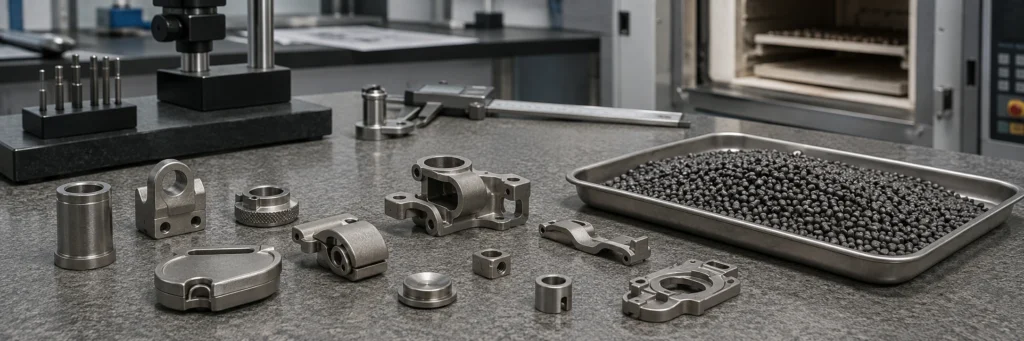
MIM Cost & RFQ Decisions / Supplier Quote Review A MIM supplier and a die casting supplier may quote very different prices for the same part drawing. Before negotiating either price, confirm what each supplier will deliver, which operations are included and whether both proposals satisfy the approved finished-part requirements. Quick answer: Compare the two …
MIM Cost & RFQ Decisions / Supplier Quote Review
A MIM supplier and a die casting supplier may quote very different prices for the same part drawing. Before negotiating either price, confirm what each supplier will deliver, which operations are included and whether both proposals satisfy the approved finished-part requirements.
Quick answer: Compare the two quotes in this order: first confirm material, critical features and final acceptance requirements; then align drawing revision, order quantities, delivery terms and the included manufacturing scope. Add tooling, required post-processing, inspection and other applicable charges to calculate the cost of the same number of accepted finished parts. If an alloy substitution or design deviation has not been approved, resolve it with engineering before ranking the prices.
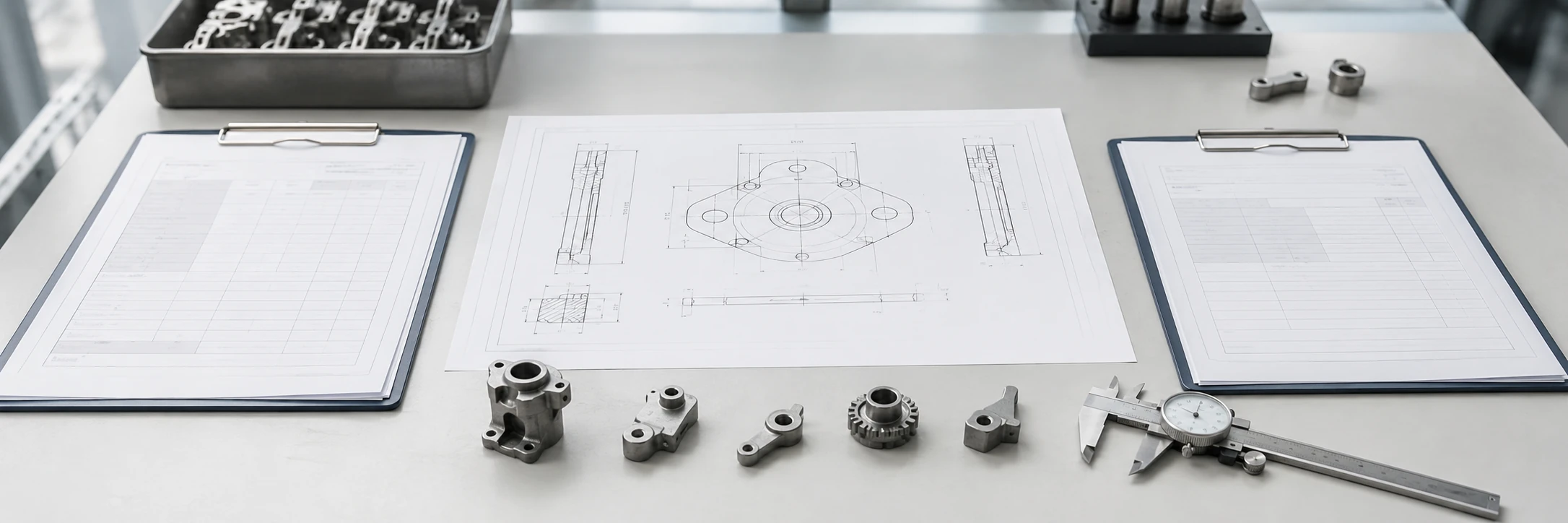
Step 1 / Technical gate
Are Both Quotes for Technically Comparable Finished Parts?
Before comparing tooling fees or unit prices, check that each supplier is offering a part that can meet the approved specification. A lower price is not directly comparable if it assumes an unapproved alloy, a wider tolerance or a different finished-part acceptance requirement.
Material and Functional Requirements
MIM suppliers may quote stainless steel, low-alloy steel or other suitable metal feedstock systems, whereas die casting suppliers may propose zinc, aluminum or other castable alloys. These are different material and process routes, not automatically interchangeable quotations. If the specification requires a particular alloy or property, that requirement remains controlling until the customer approves a change.
Where the design is performance-based rather than locked to one alloy, ask both suppliers to name the proposed material and delivered condition, including any specified heat treatment or coating. Match each proposal to the actual load case and service environment: a minimum strength requirement, a wear-contact surface and a corrosion-exposure requirement are different acceptance questions. A property value taken from a standard test specimen cannot, by itself, establish identical performance in a thin section, around a fastener or after final finishing. A proposed substitute therefore needs approval against the relevant function and, where necessary, a defined test or qualification plan.
Illustrative example - an unapproved alloy substitution (not a customer project)
The drawing specifies a corrosion-resistant stainless-steel grade, but the cheaper die casting quote assumes a zinc alloy. These offers may differ in corrosion resistance, wear behaviour and mechanical performance, so price alone cannot establish a viable substitution. Engineering should first confirm whether an alternative material is permitted, identify the service conditions and required tests, and check the material condition each supplier would deliver. Until the customer approves that route, exclude the zinc-alloy offer from a like-for-like price ranking or request a quotation that meets the mandated specification.
Critical Features, Tolerances, and Approved Design Changes
A tightly controlled mating bore may need post-sintering machining or sizing after MIM, while a die casting proposal might require reaming or a dedicated machining allowance. The cost driver is not the process label: it is the operation and verification required to meet the same final datum-based acceptance condition. Confirm whether bore size, position and surface finish are checked after every required operation, including a coating if it affects the feature. An as-sintered or as-cast dimension and an inspected, finished bearing seat are different quotation outputs.
Illustrative example - the mating bore meets diameter but not position (not a customer project)
Both suppliers quote the specified bore diameter, but one assumes an as-formed tolerance while the other includes machining and fixture inspection. The assembly also requires the bore to be positioned relative to a datum; a correct diameter does not establish that positional requirement. Ask each supplier for the proposed operation sequence, machining allowance, inspection stage, datum setup and measurement report. Until both offers cover an accepted finished bore in size and position, their prices are not equivalent.
Also check parting lines, visible surfaces, threads, undercuts, wall transitions and any process-specific geometry change. MIM shrinkage compensation and sintering support are not the same as die casting die design, slides, trimming and porosity-related controls. These process differences matter only insofar as they affect the approved part, its acceptance criteria or the cost required to reach that state. For example, MIM dimensional variation associated with sintering and die casting dimensional variation associated with tooling, solidification or trimming require different control plans; neither route should be promised to meet a critical dimension without a project-specific method and verification. Design deviations must be documented and approved before the quotes can be treated as technically comparable.
| Status | Evidence available | Buyer action |
|---|---|---|
| Comparable | Both proposals address the same approved end requirements, with a documented manufacturing approach and any required validation plan. | Proceed to RFQ and cost-scope review. |
| Needs clarification | Material substitution, tolerance capability, test plan or a design exception remains open. | Obtain written engineering clarification; label cost comparison provisional. |
| Not yet comparable | A proposal contradicts a non-negotiable requirement, or the finished-part definition differs. | Pause supplier-price selection; resolve the design or process decision first. |
For material specifications, consult MPIF's Standard 35-MIM materials resources (2025 edition). NADCA's 2024 Product Specification Standards for Die Castings address alloy properties, dimensional tolerances, GD&T, tooling and quality assurance. These standards help define the requirements to be checked; neither establishes that two proposed materials or supplier-specific processes will produce equivalent parts. That determination depends on the approved drawing and applicable validation.
Step 2 / Shared RFQ basis
Do Both Suppliers Quote Against the Same RFQ Baseline?
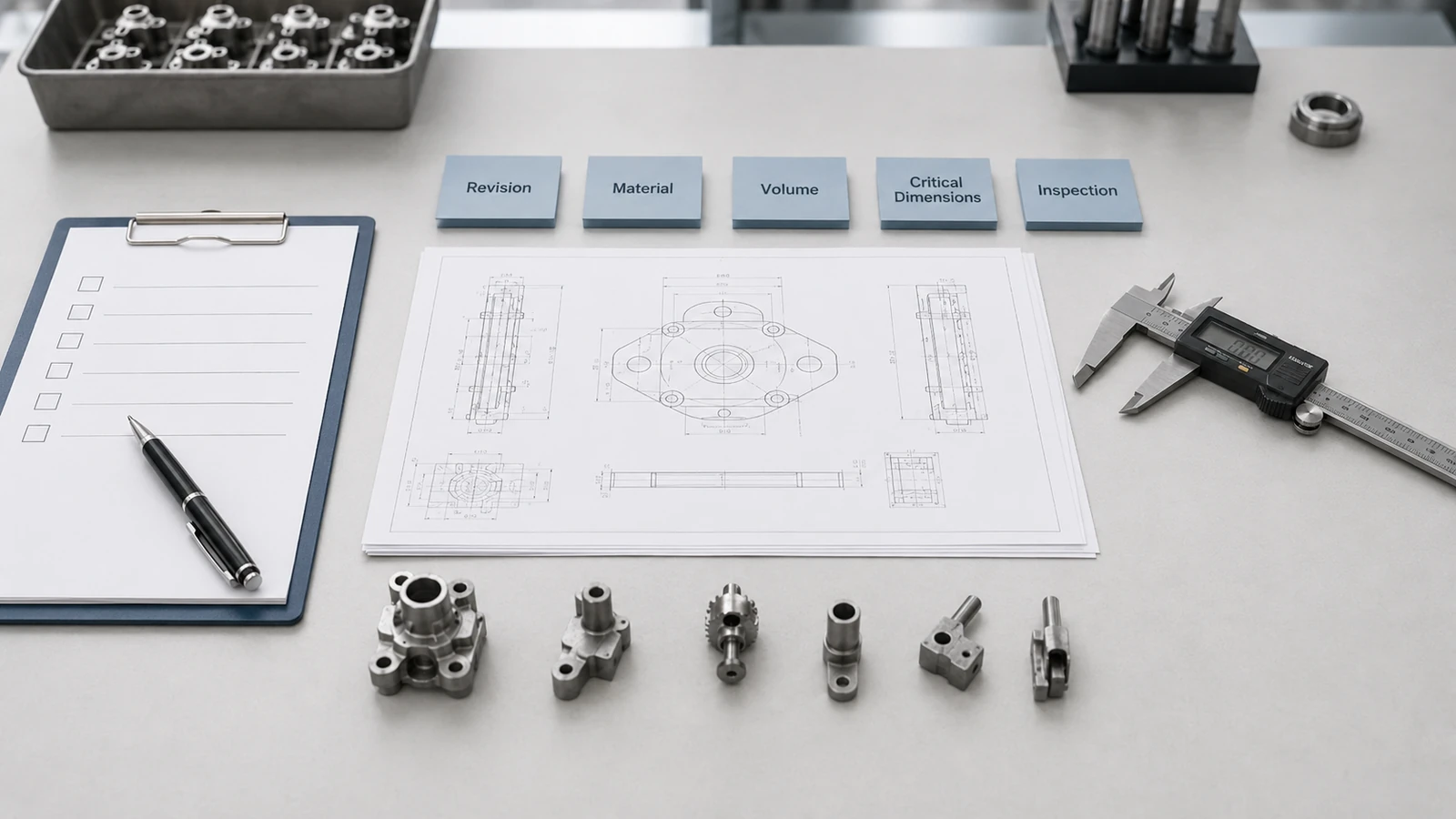
Both suppliers need the same approved product requirements and purchasing assumptions, even though their tooling and process routes may differ. Check the RFQ package before comparing figures: drawing revision, quantity per release, acceptance plan and commercial terms can all change the quoted price.
Drawing Revisions, Specifications, and Acceptance Criteria
Issue the current 3D model and controlled 2D drawing together. The model typically shows nominal geometry, while the drawing and specification identify datums, threads, critical dimensions, tolerances, material notes, cosmetic limits, heat treatment or coating, and inspection or reporting requirements. Ask each supplier to acknowledge the revision it quoted and list deviations rather than silently excluding costly features.
If engineering has approved process-specific design versions, record each revision against the same final functional targets. A fair comparison does not require identical molds, but it does require approved, deliverable finished parts. Maintain a deviation register that records the affected feature, supplier assumption, engineering disposition and approval date. An exception that is still open must remain visible in the quote comparison; it cannot be treated as part of the accepted specification.
Production Volume, Delivery, and Commercial Assumptions
Specify the annual forecast, planned total project volume, order or release quantity, target production stage, shipping basis and destination where relevant. Request quotation price breaks if demand is uncertain. MOQ, setup costs and tooling amortization may cause a price quoted at 50,000 pieces to differ materially from a price for 2,000 pieces. Annual demand does not automatically qualify each small release for a high-volume price: the supplier must accept the purchase schedule, storage or call-off arrangement and commercial commitment on which that price depends.
Illustrative example - annual volume quoted against monthly releases (not a customer project)
The buyer needs 36,000 accepted parts a year, purchased as 3,000 parts each month. Supplier A prices a single 36,000-piece run; Supplier B prices twelve monthly releases. These are different commercial commitments: setup, minimum-batch charges, storage and tooling recovery may depend on when parts are produced, paid for or shipped. Request a written quote for twelve releases of 3,000, including MOQ, handling charges, ownership of any held stock and price validity. Use the annual-run price only if the supplier expressly accepts the proposed release schedule or a suitable blanket-order arrangement.
Also align currency, quote validity, sample versus production status, payment conditions and what may trigger a re-quote. Prototype, pilot and stable production quotations describe different levels of validation and risk. They should not be compared as though they were the same offer.
| RFQ field | Common buyer baseline | Supplier-specific information to record |
|---|---|---|
| Drawings and revision | Controlled drawing, 3D file and approval history | Quoted revision; documented design exceptions |
| Material and performance | Fixed grade or approved functional specification | Proposed alloy / condition and supporting evidence |
| Critical features | Dimensions, datums, cosmetic and functional acceptance criteria | How critical features will be produced and verified |
| Quality scope | Inspection plan, test method, sampling/report needs | Included controls and any outsourced tests |
| Production basis | Annual demand, lifetime quantity, lot size, project stage | MOQ, price breaks, capacity and lead-time assumptions |
| Commercial basis | Currency, delivery terms, quote date and validity | Tool payment, ownership, exclusions and re-quote triggers |
NADCA's die, production and finishing checklists (T-2-1, C-8-1 and C-8-2) distinguish the information needed to estimate tooling and production work. For a cross-process RFQ, obtain the same clarity about specifications, assumptions and exclusions from both suppliers. The MIM RFQ preparation guide covers the drawing, material, quantity and inspection information needed when preparing the MIM side of the enquiry.
Step 3 / Quote scope audit
What Does Each Supplier Quote Include or Exclude?
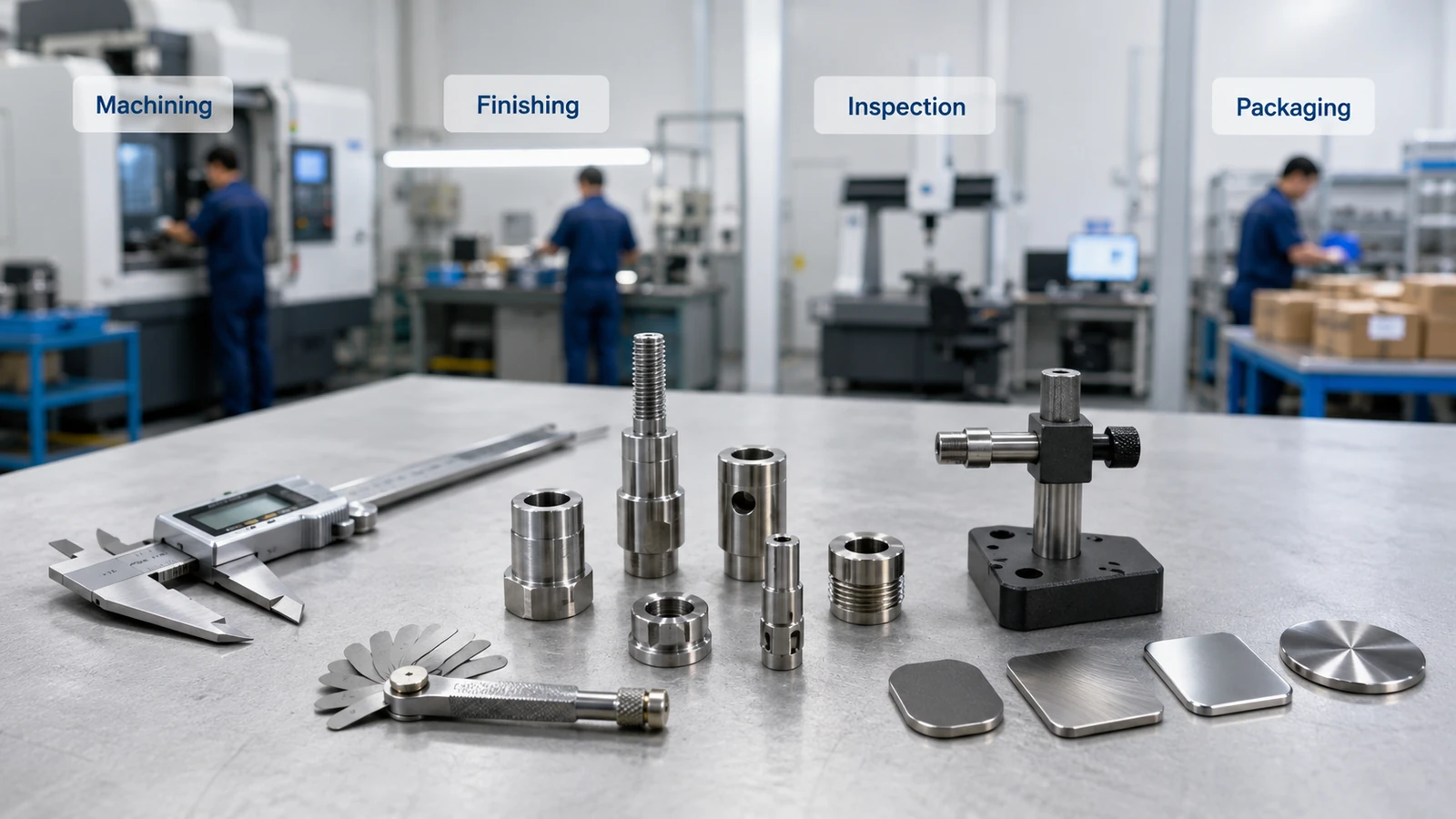
A quoted unit price covers whatever scope the supplier has specified. One offer may end at a molded or cast semi-finished component; another may include final machining, inspection and packing. Record each required operation or charge as Included, Excluded or Not Confirmed before calculating a finished-part price.
Tooling, Sampling, and Engineering Change Costs
Ask whether the quoted tooling covers tool design and manufacture, trials, initial samples, agreed correction rounds and sampling or approval documentation. A tool price is meaningful only with its deliverables and correction limits: a lower quote that excludes the first dimensional correction may create a later engineering-change charge after samples expose a fit problem. Confirm how drawing revisions, DFM-driven changes, spare components, maintenance, repair and tool ownership or storage will be handled. These conditions differ by supplier and contract; no universal tooling arrangement should be assumed.
MIM tooling design must account for feedstock filling, gates and ejection, shrinkage compensation, green-part handling and any sintering support. A part can fill successfully in the mold yet need a different support or correction plan to meet final dimensions after debinding and sintering. Die casting tooling instead needs review of parting lines, draft, cores or slides, venting, trimming and machining allowances. These differences do not require identical tools or equal tooling charges. They do require each supplier to state what the tool price covers, including trials and corrections, and whether payment is separate or recovered in the unit price. See MIM tooling amortization by annual volume for the effect of quantity on tooling recovery.
Secondary Operations, Inspection, and Packaging
Identify the exact point at which each supplier considers its part complete. Possible operations include trimming or deburring after casting, sizing after sintering, CNC machining of a critical bore, tapping, reaming, cleaning, polishing, coating, heat treatment, functional testing and protective packaging. Not every part needs every operation. For a coated cosmetic component, surface preparation, coating coverage, visible defect limits and protective packing can become separate cost and acceptance steps; for an internal functional part, some of those operations may not be specified at all. The cost comparison should follow the actual finished-part drawing, not a generic checklist of every operation a process could use.
Inspection scope can be just as important. A visual appearance check cannot verify datum-based geometry, and an attribute sampling plan cannot replace a specified variable measurement of a critical diameter or position. Confirm the feature, measurement stage, datum setup, gauge or CMM method, report format, sampling frequency, nonconforming-part treatment and whether rejected parts are replaced within the selling price. Where an attribute-based acceptance sampling plan is appropriate, ISO 2859-1:2026 defines AQL-indexed lot-by-lot sampling schemes; it does not choose the buyer's critical dimensions or prove conformance of every delivered part. This distinction matters where one quote prices produced output while the other prices accepted finished parts. More background is available in how secondary operations affect MIM RFQ cost.
| Line to confirm | What the quotation should disclose | Why the gap matters |
|---|---|---|
| Tooling and trials | Tool design / build, trials, samples, corrections, payment and ownership | One-time charges can be shifted outside the quoted unit price. |
| Base forming | Material grade, molding or casting, process stage, per-part basis | The quoted output may be raw rather than saleable finished stock. |
| Machining and sizing | Required bores, faces, threads, flatness, straightness or sizing | Critical dimensions may add recurring cost. |
| Surface and cleaning | Deburring, polishing, coating, heat treatment, cleaning | Surface requirements may not be covered by a base-part price. |
| Inspection / testing | Methods, scope, sampling, reports and acceptance responsibility | Different quality plans create non-equivalent quotations. |
| Packaging / logistics | Sorting, protective packing, delivery basis, freight if applicable | Costs may move to a later supply stage. |
| Revision and validity | Price-break assumptions, quote expiry, re-quote triggers | The attractive price might apply only to a different scenario. |
If a mandatory operation is marked Not Confirmed, the price cannot yet be treated as an accepted finished-part quotation. Request a written inclusion statement or a revised price rather than entering zero for an unknown charge. Suppliers do not always need to disclose a proprietary cost breakdown: written confirmation that a bundled price covers every specified operation and acceptance requirement may be sufficient to establish the quoted scope.
Step 4 / Cost normalization
How to Compare Total Finished-Part Cost on the Same Basis
Once the quotation scope is clear, put the confirmed charges on one comparable basis. The suppliers do not need matching internal cost breakdowns. They do need prices for the same quantity of accepted finished parts under the same purchase and delivery conditions.
Separate One-Time Costs from Recurring Unit Costs
One-time project charges may include tooling, engineering development or initial qualification when separately invoiced and applicable to the selected comparison horizon. Recurring charges may include the base part, necessary secondary operations, in-scope inspection, packaging and other per-unit charges. A mold payment at project launch is not automatically the same as a volume-based charge recovered through piece price. If a setup, minimum-order surcharge or handling fee occurs at every purchase release, multiply it by the number of planned releases rather than treating it as a one-time tooling fee. Where a tool is contractually reusable beyond the comparison period, record the ownership and remaining-life assumption instead of inventing a salvage credit.
Check for double counting and quantity basis. If a supplier's unit price already recovers the mold cost, do not add that mold charge again. If a supplier describes tooling as partly amortized and partly paid up front, obtain the amortization schedule and identify which portion each price contains. If inspection is excluded, request its applicable charge before completing the model. Where the seller quotes gross molded or cast output rather than accepted units, ask who bears normal process scrap, inspection rejects, rework and replacement; do not divide gross production cost by delivered-good quantity unless the contract actually passes that yield risk to the buyer.
Normalize Costs at the Same Volume and Delivery Basis
Choose a disclosed comparison horizon, such as the forecast number of accepted parts over a specific project period. Use the same accepted quantity, release plan, currency and agreed delivery scope. If price breaks differ, use each supplier's applicable written price for the selected lot size and purchase commitment; do not combine a small-lot MIM price with a high-volume die casting price. A price that assumes one bulk shipment may not apply to staged releases even when annual demand is identical. If exchange rate, freight, qualification or escalation differs materially, show it as an explicit scenario or unresolved line—not an invisible assumption in the unit price.
Comparable finished-part cost model
Project cost = applicable one-time charges + (confirmed finished-part unit cost × accepted quantity) + applicable fixed release or delivery charges
Effective cost per accepted part = project cost ÷ accepted quantity
Here, confirmed finished-part unit cost means the price payable for each accepted finished part, including mandatory processing and inspection under the agreed scope. Applicable one-time charges must be counted once within the chosen comparison horizon; fixed release charges must reflect the actual number of purchase releases. Use this model only after exclusions and billing assumptions are resolved. Supplier price breaks, payment timing, tool life, currency and freight can require separate scenarios.
1 / Scope
Count only costs needed to meet the same approved finished-part requirement.
2 / Quantity
Use the same accepted-part volume, forecast horizon and purchase-release basis.
3 / Evidence
Keep unpriced, estimated and supplier-confirmed cost items visibly separate.
A total-cost comparison is ready only when both proposed finished parts satisfy the approved requirements and all charges that could affect the decision have been confirmed. Keep unresolved costs and technical exceptions open for written clarification instead of presenting a precise total built on assumptions.
Step 5 / Worked comparison
Worked Example: Comparing MIM and Die Casting Supplier Quotes
Illustrative example only - not a customer quotation
Consider an illustrative RFQ for a small, non-structural mechanism component. Engineering has approved both proposed material and design routes against the same functional targets and finished-part inspection requirements. The planned purchase is 20,000 accepted parts over two years, released in four lots of 5,000. For this example, both suppliers confirm in writing that their USD unit prices, MOQ and EXW terms apply to all four releases, with no added release fees or escalation. Each separately invoiced tool charge covers agreed initial trials and samples and is not included in the part price. An actual project needs the same conditions confirmed in its written quotations.
Original Supplier Quotes and Missing Cost Items
The MIM supplier quotes $2.85 per accepted finished part, including required machining, finishing, inspection and bulk packing, plus a separate $5,500 tooling charge. The die casting supplier quotes $1.95 for casting and trimming only, with a separate $7,000 tooling charge. Although the die casting unit price appears $0.90 lower, it does not yet include the operations needed to deliver the same finished part.
| Quote line | MIM supplier | Die casting supplier | Comparison status |
|---|---|---|---|
| Original piece price | $2.85 | $1.95 | Not comparable: finished part versus cast-and-trimmed part. |
| Tooling, separately charged | $5,500 | $7,000 | Comparable after tooling scope and payment are confirmed. |
| Final machining | Included | Excluded; needs price | Request the missing recurring cost. |
| Finish, inspection, packaging | Included | Excluded; needs prices | Request equal acceptance and delivery scope. |
Normalize the Quotes and Interpret the Result
The die casting supplier then confirms the extra finishing charges in a revised written quote: $0.48 for machining, $0.16 for finishing, $0.12 for inspection and $0.08 for packing, all per accepted part. Added to the $1.95 cast-and-trim price, these items produce a recurring cost of $2.79 per accepted finished part. Both suppliers also confirm that their prices include normal production yield losses and cover the agreed quantity of accepted parts without extra charges for rejected in-process output.
| Cost component | MIM supplier | Die casting supplier |
|---|---|---|
| Base quoted unit price | $2.85 (finished) | $1.95 (cast and trimmed) |
| Additional final machining | Included above | +$0.48 |
| Additional finishing | Included above | +$0.16 |
| Additional inspection | Included above | +$0.12 |
| Additional packaging | Included above | +$0.08 |
| Confirmed recurring cost / accepted part | $2.85 | $2.79 |
| Recurring cost for 20,000 parts | $57,000 | $55,800 |
| Separately paid tooling | $5,500 | $7,000 |
| Illustrative project cost | $62,500 | $62,800 |
| Effective cost / accepted part | $3.125 | $3.140 |
Illustrative USD / EXW costs for four releases of 5,000 accepted parts. Tooling is paid once; both unit prices apply to the full schedule and include normal yield losses. Freight, import charges and any other project-specific fees must be included or separately identified when comparing actual supplier offers.
After the missing operations and separate tooling charges are included, the example totals $62,500 for MIM and $62,800 for die casting. The difference is just $300 across 20,000 accepted parts, or $0.015 per part, despite the original $0.90 unit-price gap. A margin this small can be affected by a finishing change, inspection requirement or a different release schedule. The award decision still depends on approved performance, qualification, quality and delivery risk; these figures do not establish a general cost advantage for MIM.
If a previously omitted MIM charge of $0.02 per accepted part were added in this illustration, the total would increase by $400 to $62,900 - $100 above the die casting figure. No such charge is being asserted; the calculation shows how easily an unconfirmed cost can overturn a narrow price difference. At another order quantity, changes in price breaks, tool life, design or contract terms could produce a different outcome.
If a supplier still marks a mandatory charge Not Confirmed, leave the corresponding comparison open. Record the missing item, the responsible contact and the required response date. Use a revised quotation or written inclusion confirmation before presenting the result as a sourcing recommendation.
Step 6 / Sourcing decision
What Should Buyers Do After Reviewing Both Quotes?
A comparable project cost resolves the arithmetic, but it does not approve a supplier or an unverified material change. Where both quotes meet the technical requirements, purchasing can assess quality evidence, lead time and contractual risk before selection. If the product requirement or manufacturing route remains unresolved, engineering must decide what needs validation before price can be decisive.
| Result | Trigger | Next action |
|---|---|---|
| Proceed to supplier selection | Approved technical targets, complete quote scope and comparable costs are documented. | Evaluate quality evidence, schedule, project risk and commercial terms before award. |
| Request a revised quote | Missing operation, different quantity break, unclear tool amortization or unaligned delivery terms. | Issue a clarification list and require a revised written quotation on the shared RFQ baseline. |
| Return to engineering review | Unapproved material, unresolved functional tolerance, geometry limitation or uncertain process suitability. | Resolve the design / DFM / validation issue before treating the prices as comparable. |
Send the same five clarification questions to each supplier. Ask for answers against the controlled RFQ revision and keep the replies with the comparison record. Refer material changes, critical dimensions and other technical exceptions to the responsible engineer rather than relying on a pricing response alone.
- Which drawing revision and material/performance requirements did you quote? Ask them to list every deviation.
- Which operations are included after molding or casting? Request machining, finishing, inspection and packaging line items or an explicit inclusion statement.
- Which dimensions or features drive technical or quotation risk? Request the planned control method and any DFM caveats.
- How is tooling charged or amortized? Confirm samples, correction rounds, quantity assumptions and tool ownership terms.
- What would trigger a revised price? Confirm changes to material, drawing, acceptance plan, volume and schedule.
If the price difference traces back to part size, mass or section geometry, review the part size and weight triggers for MIM vs die casting with the engineering team. Where the manufacturing route itself is still in question, the broader MIM vs Die Casting comparison addresses process suitability before a revised RFQ is issued.
Return to engineering when the offers solve different technical problems. More prices cannot resolve an unapproved material substitute, an undefined positional tolerance or disagreement over achievable final geometry. Settle the specification and DFM assumptions first, then obtain quotations for the accepted scope.
For a broader audit of supplier capability, quality systems and project delivery beyond quotation contents, see the separate MIM supplier evaluation checklist.
Step 7 / Practical worksheet
MIM vs Die Casting Supplier Quote Comparison Checklist
Record the evidence behind both supplier quotations in this worksheet. Mark each line Confirmed (C), Needs clarification (N) or Not comparable (X), and include the relevant quotation or drawing reference and next action. The blank fields are designed to be copied or printed; this web page does not store entries.
Project details: Part no. __________ RFQ revision __________ Reviewer / date __________ Comparison period and quantity __________ Currency / delivery basis __________
On a phone, swipe sideways across the table to see both suppliers, missing evidence and next actions. You can also tab into the table and scroll it with a keyboard.
| Review item | MIM quote / evidence | Die casting quote / evidence | Gap or missing proof | Next action |
|---|---|---|---|---|
| 1. Approved material and function | ____________ | ____________ | ____________ | Engineering approval? |
| 2. Drawing and revision | ____________ | ____________ | ____________ | Align revision |
| 3. Critical features / acceptance | ____________ | ____________ | ____________ | Clarify tolerance / test |
| 4. Quantity, lot size and MOQ | ____________ | ____________ | ____________ | Confirm price break |
| 5. Tooling, samples and changes | ____________ | ____________ | ____________ | Obtain tool scope |
| 6. Tool payment / amortization | ____________ | ____________ | ____________ | Check double counting |
| 7. Machining / sizing / tapping | ____________ | ____________ | ____________ | Confirm inclusion |
| 8. Finish, cleaning and coating | ____________ | ____________ | ____________ | Confirm inclusion |
| 9. Inspection and test reporting | ____________ | ____________ | ____________ | Align QC scope |
| 10. Sorting, packaging and delivery | ____________ | ____________ | ____________ | Align delivery basis |
| 11. Validity and re-quote triggers | ____________ | ____________ | ____________ | Confirm in writing |
| 12. Comparable project cost | ____________ | ____________ | ____________ | Choose / re-quote / DFM |
Close each open item: Enter C, N or X in each supplier column with a document reference, such as "C - Quote B, line 6". Use the gap column to identify the missing cost or acceptance evidence and name the purchasing or engineering owner. An unapproved material change or mandatory unpriced operation prevents a final like-for-like comparison. Record whether the next action is approve a deviation, request a revised quote or return to DFM, with a due date and the relevant approval or updated quotation.
Need to clarify MIM process fit before finalizing a quote?
When material suitability, geometry, sintering-related dimensional control or secondary machining is still uncertain, submit the controlled 2D drawing, 3D STEP file, intended material, annual demand and critical acceptance requirements for an engineering review. These inputs allow the required MIM operations, inspection scope and quotation assumptions to be assessed before tooling.
Two quotations are ready for commercial comparison when both cover an approved finished part, the purchasing conditions match and the cost of each required operation is accounted for. Where any of those conditions remains open, record the gap and obtain written supplier clarification or an engineering decision before selecting on price.
Frequently asked questions about supplier quotes
Can I compare a MIM quote and a die casting quote by unit price only?
Not unless both prices already cover the same approved finished-part requirements. Check the material and functional acceptance criteria first; then confirm tooling treatment, machining, inspection, quantity and delivery terms. If any mandatory scope is unpriced, request a written clarification before comparing totals.
Why does a MIM quote sometimes look higher than a die casting quote?
One quotation may include sintering-related dimensional control, sizing, finishing, inspection or a different tooling-payment arrangement while the other covers only a cast-and-trimmed component. Material specifications and approved tolerances can also differ. Ask for a scope and process-assumption statement; price alone does not identify which process is more economical.
What if one supplier includes machining and the other does not?
Identify which finished features actually require machining, then request the omitted operation, inspection and related setup charges in writing. Either obtain an all-in accepted-part quote or use separately priced steps to build the same finished-part scope. Do not assume that an excluded operation costs zero.
Can a supplier use a 50,000-piece price when my purchase orders are only 5,000 pieces?
Only if the supplier confirms that price for the proposed release schedule or binding blanket-order terms. Ask whether each 5,000-piece release meets the MOQ, whether setup or inventory charges apply, and when the price can change. Annual forecast volume alone does not establish the release price.
Can I compare a cheaper alternative alloy without engineering approval?
Not as an equivalent finished-part quotation. Record the proposed material and delivered condition, identify the controlling strength, corrosion, wear and other functional requirements, and obtain customer or engineering approval with necessary verification before putting the alternate route into the same price ranking.
Does an AQL sampling plan replace inspection of critical dimensions?
No. ISO 2859-1 describes lot-by-lot acceptance sampling by attributes. A critical diameter, position or datum-related tolerance still needs an agreed measurement method, inspection stage and reporting plan. The buyer and supplier must specify how both acceptance sampling and critical-feature verification apply to the project.
XTMIM engineering review: A MIM RFQ is assessed against the controlled drawing, material suitability, tooling feasibility, debinding and sintering constraints, critical dimensions and any machining or inspection needed for the finished part. Pricing and production approval remain subject to the confirmed application requirements and project-specific feasibility review.